Interactive e-learning content is presented with activities that engage the learner, multimedia content, real-world scenarios, assessments, and a constant stream of feedback that motivate participation and retention of knowledge. When developed effectively, e-learning engagement content helps the organisation to shift learners from “watching to doing” and achieve measurable improvements in job performance.
What Is Interactive E-Learning Content?
Interactive e-learning content refers to online learning material that demands learners to actively engage in it by clicking on links, making choices, engaging in simulations, or doing assessments. This is an active involvement, as opposed to the regular slide courses where the learner does not have much chance to be involved.
Interactive Learning Features
| Feature | Benefit |
| Scenario-Based Learning | Improves workplace application of skills |
| Interactive Quizzes | Reinforces knowledge through active recall |
| Videos | Increases learner attention and comprehension |
| Gamification | Boosts motivation and course completion |
| Simulations | Builds practical, hands-on competence |
A compliance module where the learner has to select the right answer to a situation in a workplace will capture the learner’s attention much more than a simple policy document. Instructional designers purposefully design these interactions to correlate the interaction with a learning objective and not for interactivity alone.
Why Is Learner Engagement Important in Online Training?
In online training, it is crucial to engage the learner, as they are less likely to retain information if they are not engaged in the training, are less likely to finish the training, and are less likely to use it in the workplace after the end of training. Investing in e-learning engagement content directly influences whether training investments translate into measurable performance improvement.
If employees simply look at slides and don’t absorb content, an organization implementing a new sales process will likely not get the benefits. Engagement from the ground up leads to meaningful course behavior change vs a “check the box” approach to training.
How Does Interactive Learning Improve Knowledge Retention?
Interactive learning skills enhance knowledge retention because learners have to process and apply the knowledge that is being learnt, resulting in better knowledge formation than passive learning of reading or watching. In adult learning, it is important to remember that learning remains after practicing a skill more than watching a skill.
A video showing hazards is not as effective as a safety training course that also has a hands-on simulation of hazard identification. Instructional designers are using interactive modules with spaced repetition and retrieval practice to enhance retention over time.
What Types of Interactive Activities Increase Participation?
Branching scenarios, drag-and-drop exercises, quizzes, simulations, and short polls, which ask about decision-making during a course, are among the types of interactive activities that encourage participation. The formats will engage students instead of having them move through the content.
A customer service course may have a branching scenario in which the student has to make a decision on how to answer a rude customer, and the answer can lead to a different situation. This format of decision-making is closer to real working situations than simply a dump of information.
How Does Scenario-Based Learning Improve Workplace Skills?
Scenario-based learning incorporates learners into realistic scenarios to practice and make decisions: just like working out there, learners are placed in scenarios that closely simulate the real world and in which they have to make decisions and use their knowledge. This practice is more effective at gaining confidence and competence than abstract teaching.
A new manager training program may include a situation where a team member is not working up to their potential, and the learner is asked to choose a suitable response to the situation. Making these decisions in a low-risk online environment can help the employee to be better prepared to make the same decisions in the workplace.
Why Are Videos and Multimedia Important for Digital Learning?
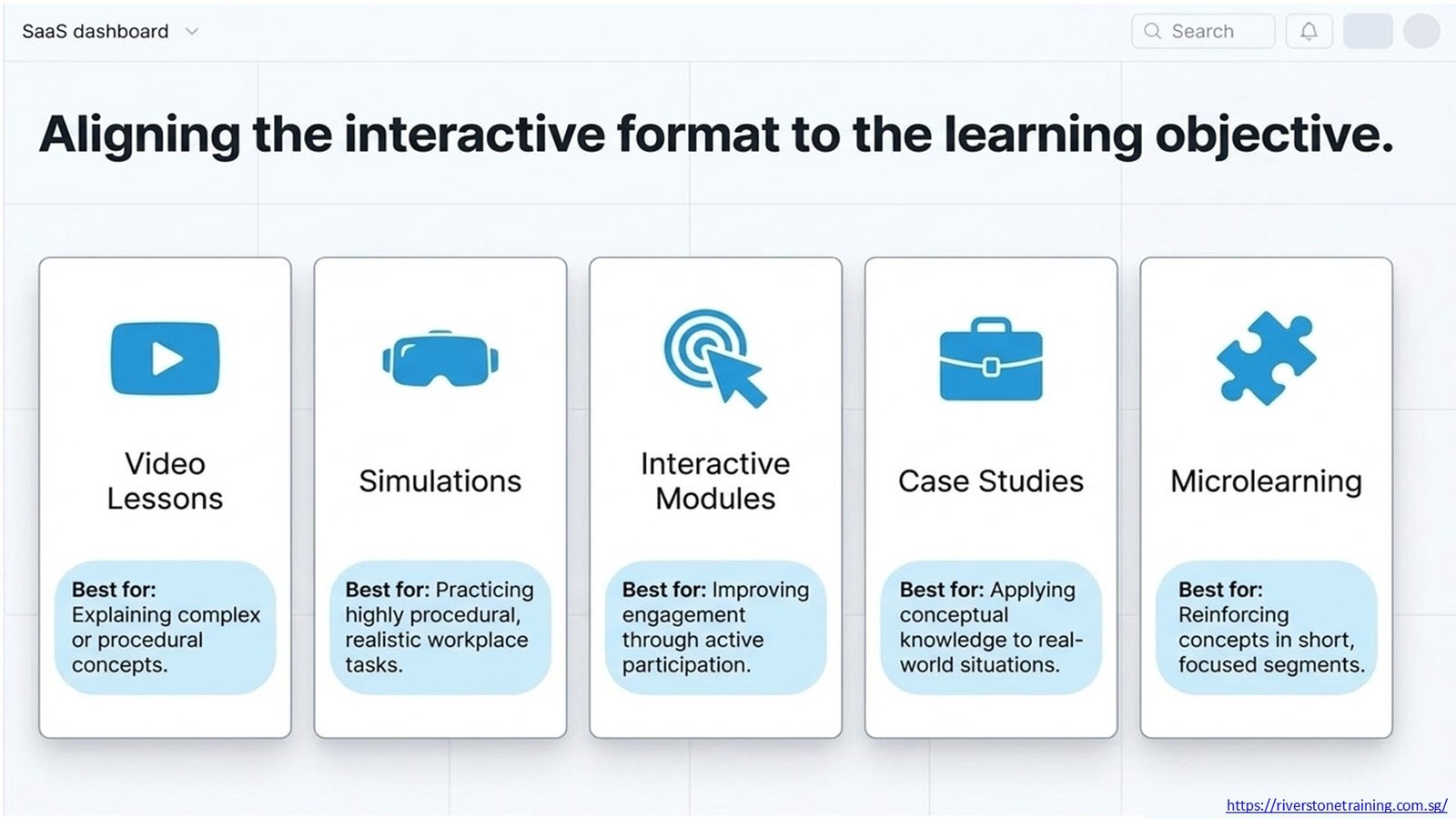
Videos and multimedia are crucial elements of digital learning because they cater to different learning styles, best clarify complex ideas, and can better engage students than text alone. Procedural or technical skills are best taught using visual demonstrations.
Digital Training Content Formats
| Content Type | Best Use |
| Video Lessons | Explain complex or procedural concepts |
| Simulations | Practice realistic workplace tasks |
| Interactive Modules | Improve engagement through active participation |
| Case Studies | Apply knowledge to real-world situations |
| Microlearning Segments | Reinforce concepts in short, focused sessions |
A manufacturing safety course where a short video is shown on how to use equipment correctly is more effective than when a written procedure is given. Incorporating video, audio narration and visual graphics in one module also assists in catering to different preferences and needs among learners.
How Do Quizzes and Assessments Reinforce Learning?
Quizzes and assessment activities are effective in reinforcing the learning; recall and application activities that require the learner to retrieve and use information they have just learned help to form stronger long-term memories than passive review activities. Assessments also provide a clear indicator of understanding to both students and organizations.
It is important that a short knowledge check is given after every section of a module, instead of a test at the end of a long module, to allow for incremental consolidation of knowledge. Immediate feedback on incorrect answers, “to which the learner is given an explanation of why the answer was incorrect,” further reinforces the learning effect.
How Does LMS Content Analytics Improve Learning Outcomes?
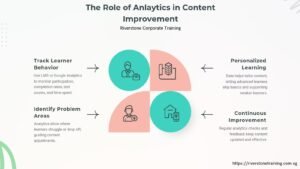
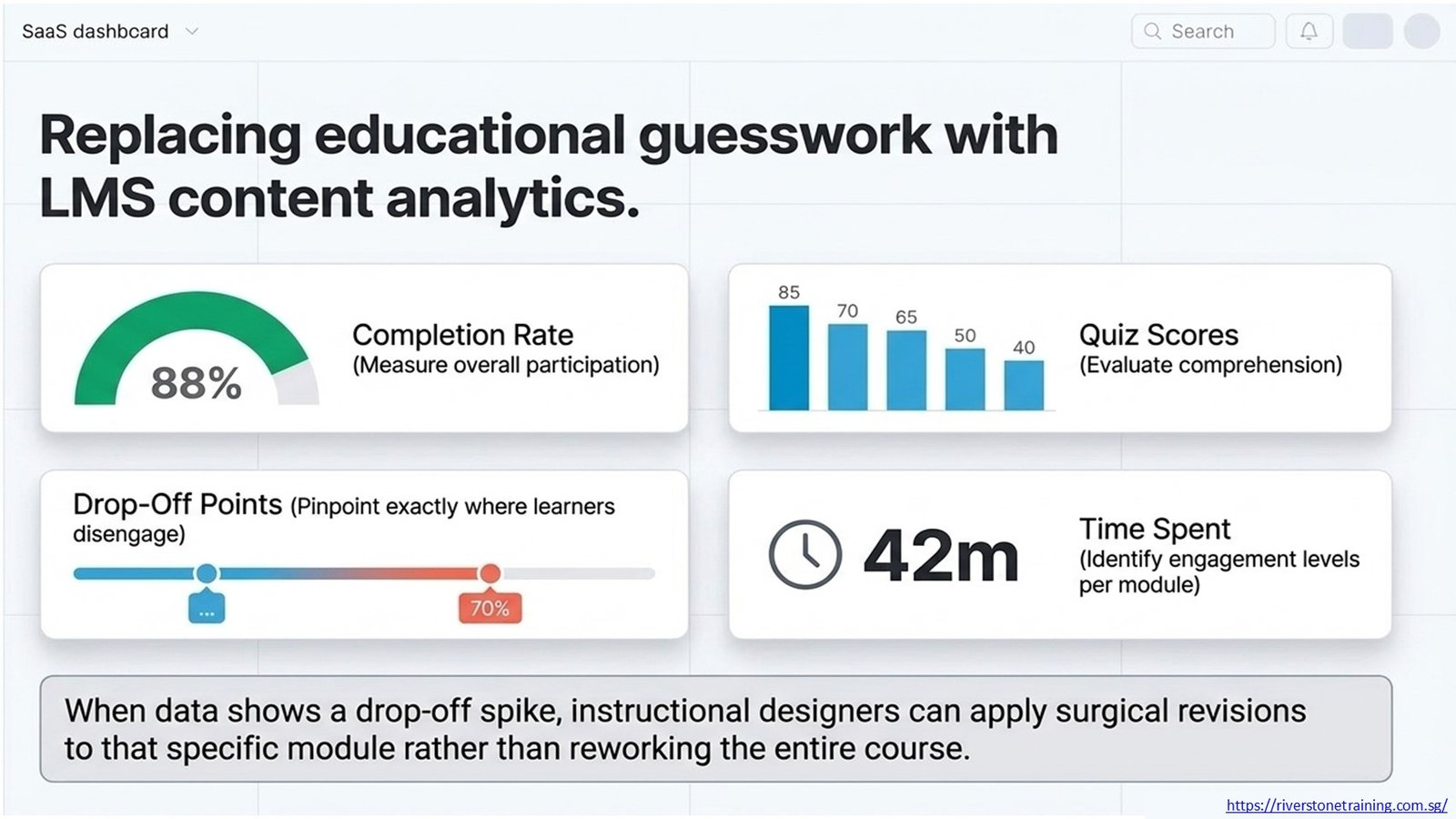
LMS content analytics supports learning outcomes by providing organizations with insights into course completion rates, quiz performance, time spent, and drop-off points throughout a course, which allows for course-based data-driven content refinement. Reviewing LMS content analytics helps L&D teams identify exactly where learners disengage, so revisions can target the specific sections causing friction rather than reworking an entire course.
LMS Content Analytics Metrics
| Metric | Purpose |
| Completion Rate | Measure overall participation |
| Quiz Scores | Evaluate comprehension and retention |
| Time Spent | Identify engagement levels per module |
| Drop-Off Points | Pinpoint where learners disengage |
| Learning Progress | Track development over time |
When analytics show that a significant number of learners drop a course at a specific module, instructional designers have the opportunity to examine that module to determine if it is too lengthy, too complex, or not interactive enough. This evidence-driven, focused course improvement process is much more effective than ‘educational guesswork’.
How Can Personalized Learning Increase Learner Motivation?
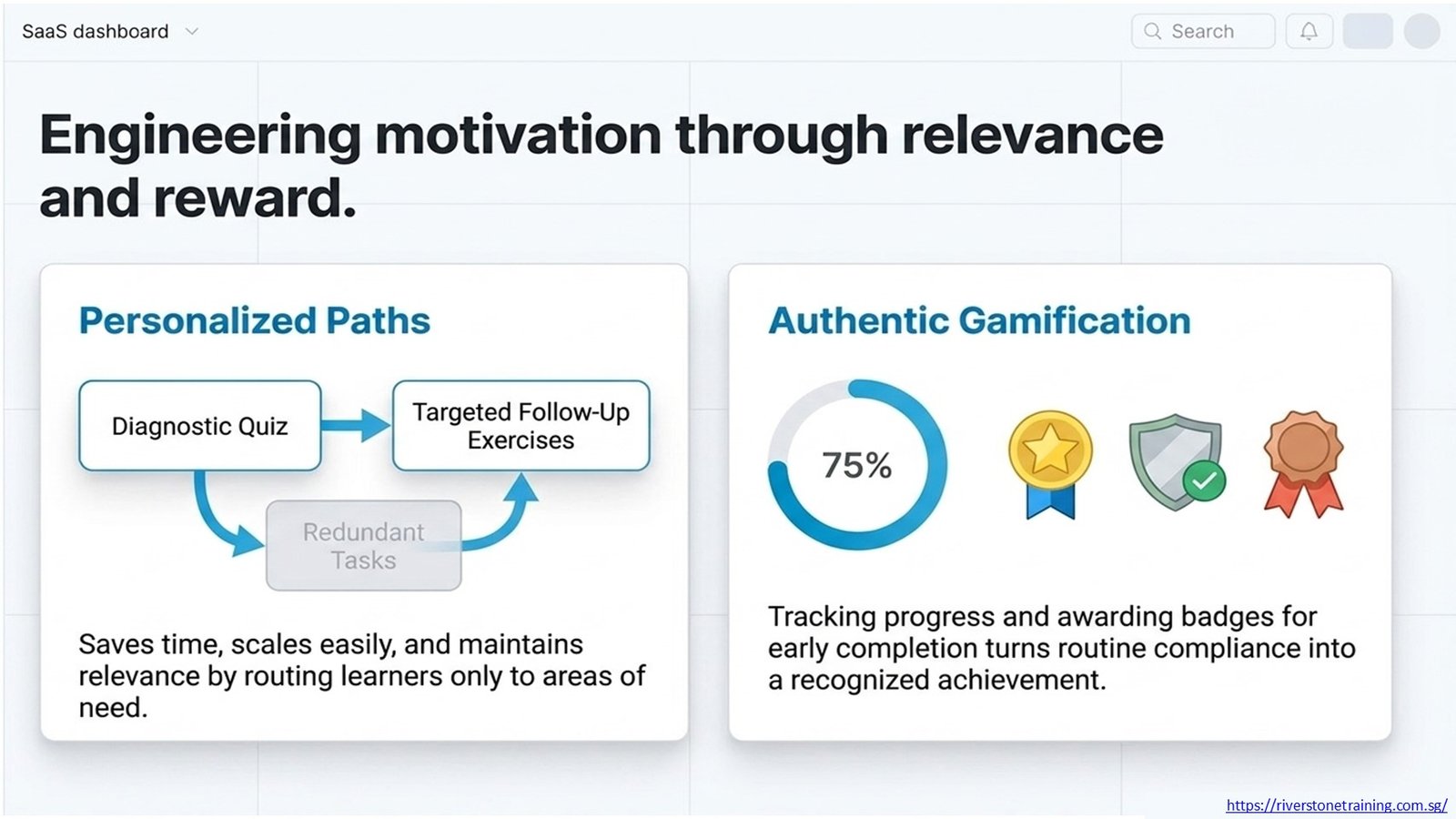
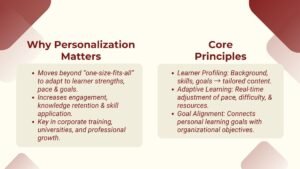
Personalized learning makes learning more relevant to a learner’s role, prior knowledge, or performance by providing content, pace, and skill level that is tailored to each individual. Content that is relevant to the student’s job is more likely to keep them interested.
A sales training tool that uses a quiz to identify the areas where a learner is stronger or weaker and only provides follow-up exercises in areas of need doesn’t waste a learner’s time and existing skills with redundant tasks. This prescriptive method also enables businesses to scale training for roles while maintaining relevance.
What Role Does Gamification Play in E-Learning Engagement?
Gamification is used in the context of e-learning engagement to motivate individuals, such as by adding points, badges, leaderboards, and tracking their progress, which can drive a sense of achievement and recognition within a learning environment. These mechanics can make normal training seem more rewarding to complete.
Learner Engagement Strategies
| Strategy | Learning Outcome |
| Personalized Learning | Higher engagement through relevant content |
| Microlearning | Better retention through shorter segments |
| Immediate Feedback | Faster correction and improvement |
| Interactive Simulations | Practical, applied skill development |
An educational program with badges for finishing modules, such as the one mentioned above, which are awarded for finishing modules ahead of schedule, can have an immediate impact on completion rates when compared to a simple course that does not include any gamification elements. Gamification is most effective when it is used in a way that is connected with authentic learning achievements and is not used just on top of different content.
How Can Organizations Measure Learner Engagement?
Organizations can use learner completion rates, quiz scores, learner time in each module, and repeated use of course materials, along with qualitative feedback from learner surveys, to measure learner engagement. These metrics collectively are more comprehensive than any one data point.
A high completion rate with low quiz scores in a course can suggest that students are not actually absorbing the course material but are just going through the motions, which could mean they need to be given more interactive opportunities for assessment. When paired with quantitative data from an LMS, learner feedback can be used to help L&D teams accurately identify engagement problems.
What Common Mistakes Reduce Learner Engagement?
Learner disinterest is caused by a variety of factors, such as the length of the module, slides that contain too much text with no interaction, content that is not relevant to the actual job of the learner, and a lack of feedback along the way. These challenges lead to learners dropping out of training well before it’s done.
A single 45-minute course without breaks, quizzes, or interactive checkpoints, for example, is much more likely to be dropped than the same material presented in shorter pieces that are interactive and provide checkpoints. It is important for effective instructional design to identify and rectify these design errors early on in the course development process because it is likely that it will be much easier to fix the course after implementation than to fix it after learners have lost interest in the course.
How Does Digital Training Content Support Corporate Learning?
Digital training content can be used to train large or dispersed teams with consistent training and can be used at the learner’s own speed, making it ideal for corporate learning. This scalability ensures that organizations can train their employees at various locations while maintaining uniformity. Structured digital training content helps organizations build practical workforce skills across specialized areas, supporting broader corporate learning initiatives beyond any single course.
For instance, the same interactive course can be introduced to all regional offices of a multinational company at once, so that everyone understands the same data privacy policy. It’s hard to maintain this consistency when relying on in-person training, especially for companies that have remote team members.
Why Should Organizations Continuously Improve E-Learning Content?
It’s important to continuously refine e-learning content to keep it relevant to learners’ needs, job requirements, and engagement patterns as they change over time, and because content that worked well last year may not work as well this year. Regularly reviewing training, it ensures that it remains relevant and aligned to the current priorities of the business.
Looking at LMS analytics quarterly, for instance, can yield a list of less-engaged older modules that require refreshing with new examples or interactive features. If the e-learning content is seen as a living resource and not a one-off production, it will be effective over time.
How Can Interactive Learning Build Long-Term Employee Performance?
Learning that involves repetition, feedback, and application to develop skills helps create long-term employee performance, which is not achieved by one-off information sessions. Continuous reinforcement makes knowledge seem to translate into consistent on-the-job behavior.
Summary: E-Learning Engagement at a Glance
| Engagement Element | Key Takeaway |
| Interactive Design | Turns passive viewing into active participation |
| Multimedia & Scenarios | Supports varied learning styles and application |
| LMS Content Analytics | Enables data-driven course improvement |
| Continuous Refinement | Keeps digital training content relevant over time |
Conclusion
Interactive e-learning content is designed to engage the learners by incorporating active learning activities, multimedia elements, real-life scenarios, and ongoing feedback, thereby transforming passive learning into meaningful practice. Great instructional design, personalization, and gamification all help to enhance participation and knowledge retention.
Content is key to a well-designed e-learning engagement experience, and the analytics capabilities of an LMS can help organizations track their content and continually enhance the effectiveness of their training based on real learner data. Digital training content, in turn, enables scalable training of the workforce in various business environments and industries.
Creating a truly engaging training isn’t an investment in content; it’s an investment that is measured and continually refined. The organizations that want to improve the engagement and performance of learners should focus on learning content that is interactive and data-informed and continuously evolves to meet the needs of their employee base.