Good learning goals, learner-centered design, activities, and measurable outcomes are essential to the production of effective e-learning course content. Instructional design, content knowledge, and assessments can be used together to design online training that enhances knowledge retention and efficacy in the workplace.
What Makes E-Learning Course Content Effective?
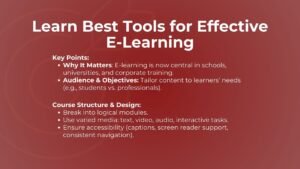
Good e-learning course content not only delivers clear learning outcomes but also helps to keep students engaged during the learning process. Designing content around what learners will need to do differently after training – not what they need to know. Good online courses have a learner-centred approach, focusing on the learner’s experience and pace, and how they use the knowledge, with content presented in logical steps and in manageable chunks.
The principles of adult learning are also an important part of the successful design of courses. When adults learn about issues that relate to their jobs, when they can use what they learn right away, and when they are in control of their learning process. These principles are integrated into practice activities, reinforcement exercises, and assessments that guarantee retention and practice in real-world situations.
The following table illustrates how learning objective types align with measurable outcomes:
| Learning Goal | Bloom’s Taxonomy Level | Example Outcome | Measurement Method |
| Knowledge | Remember / Understand | Identify the steps in a compliance process | Multiple-choice quiz |
| Comprehension | Understand / Apply | Explain why financial control matters | Short answer or scenario |
| Skill | Apply / Analyse | Perform a task using the correct procedure | Practical simulation |
| Application | Evaluate / Create | Solve a workplace problem independently | Case study or project |
| Behaviour Change | Synthesise | Consistently apply new practices on the job | Manager observation or KPI tracking |
How Do You Identify Learning Objectives Before Creating Content?
The learning objectives are determined by analysing the gap between the learners’ performance and the desired performance following training. All e-learning course material should be able to be traced back to one or more well-stated objectives so that the training is targeted and has a result.
SMART objectives are objectives that are Specific, Measurable, Achievable, Relevant and Time-bound. Specific objectives should be clear statements of what needs to be achieved, for example: after completing this module, learners will be able to prepare an accounting period P&L statement using the standard accounting period statement format.” Instructional designers work with content experts and other stakeholders involved in the business to identify these goals before they begin creating an e-learning course to ensure that the content is relevant to the business rather than its own interests.
How Does Audience Analysis Improve E-Learning Course Content?
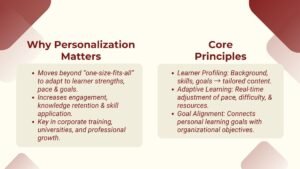
Audience analysis enhances the content of e-learning courses by providing the correct level of difficulty, examples, and challenges that the learners will experience in their roles. If this analysis isn’t performed, content will be too complicated, too simple or simply too irrelevant. The following areas should be explored: Prior Knowledge, role & responsibilities, technology access, language proficiency and motivation to learn.
These factors directly impact the design decisions; each learner group will need a different approach. While compliance training for frontline staff will be vastly different from advanced financial modelling training for senior analysts, corporate trainers designing compliance training will make very different choices. For instance, an onboarding programme for a global logistics company would employ more basic language and industry-specific examples, and require a lesser amount of prior industry knowledge than a professional development course for seasoned HR managers.
How Do Instructional Designers Structure Learning Modules?
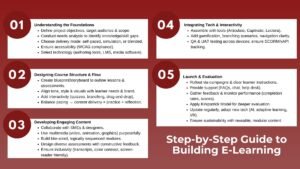
Instructional designers design learning units based on a systematic process that involves analysing and evaluating. The most popular model is the ADDIE model, which outlines a progression that e-learning content development teams can follow.
The content development process follows these key stages:
| Stage | Key Activity | Output | Purpose |
| Analysis | Identify learner needs and performance gaps | Needs analysis report | Define requirements |
| Design | Write objectives, create storyboards, map content | Design document/storyboard | Organise learning structure |
| Development | Build slides, videos, interactions, assessments | Draft course modules | Produce learning materials |
| Implementation | Deploy to LMS, run pilot testing | Live course | Deliver training |
| Evaluation | Gather feedback, review assessment data | Evaluation report | Measure and improve outcomes |
The content is designed (with simple-to-complicated progressions), supported by worked examples before practice activities, and has immediate feedback on assessments within every module. This process is extremely important and involves a staging process called storyboarding, which enables designers to plan each screen, each interaction, and each assessment prior to the development process commencing.
Having a properly laid out storyboard will stop expensive revisions in development and make sure that the subject matter experts, stakeholders, and developers are all on the same page prior to production. The e-learning content development guide gives a detailed way to do this in practice, step-by-step.
What Content Formats Work Best for Online Learning?
The best method of content will depend on the learning goal, audience, and topic. There is no format that fits all situations, so it is important to choose the formats wisely based on the learner’s needs, where experienced instructional designers have the knowledge and skills to do so.
| Content Format | Best Use Case | Audience Fit | Development Complexity |
| Video (talking head) | Concept introductions, leadership messages | All learners | Medium |
| Screencast/demo video | Software training, process walkthroughs | Technical staff | Medium |
| Scenario-based module | Decision-making, compliance, soft skills | Experienced professionals | High |
| Infographic | Visual summaries, data comparisons | Visual learners | Low |
| Quiz/knowledge check | Reinforcement and formative assessment | All learners | Low to Medium |
| Simulation | Practical skills, safety training, technical tasks | Frontline staff, specialists | High |
| PDF job aid | Reference material, process checklists | All learners | Low |
| Podcast/audio | Conceptual content, leadership topics | Commuters, remote workers | Low to Medium |
Deciding on the optimal combination of formats is one of the most critical decisions to make in designing an e-learning course content. A compliance course may include modules for the scenarios to practice judgment based on them, with brief knowledge checks and a downloadable reference guide.
How Can Multimedia Improve Learner Engagement?
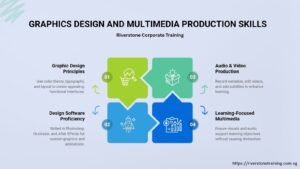
Multimedia is more effective for involving learners by presenting information in several media that facilitate deep learning because several media can give information to the learners so that it can be understood by the senses. Media learning theory states that visual and verbal stimuli are more effective than verbal stimuli alone. Multimedia in e-learning course content may be used effectively by providing narrated animation to explain a process, video for practical, interactive diagrams for exploration, and a video of a scenario for a realistic workplace situation.
The principle of good design is congruence between learning objectives and the multimedia components. Each media element needs to have a clear instructional purpose and not be used just for looks. Screencasts and simulated software environments can be used for technical training programmes, as learners can make decisions in a ‘safe’ environment to experience the impact of those decisions before they take place in real-world scenarios; for compliance training, branching video scenarios can be used to help learners experience the possible consequences of various decisions before they actually have to make them.
How Does E-Learning Content Development Incorporate Assessments?
Assessments are integrated throughout the process of e-learning content development, at two levels: formative assessment, to check for understanding within e-learning modules; summative assessment, to determine whether learning objectives were met at the end of a course. Formative assessment items are knowledge checks, drag-and-drop activities, true/false, and short reflection questions. The activities are designed to help consolidate learning and give instant feedback, but don’t score points.
Summative assessment – this may be in the form of an end-of-module quiz, a case study, or a practical task and is used to provide evidence that a learner’s required standards have been met. Assessment data is gathered via the learning management system (LMS) to monitor completion rates and identify any gaps in knowledge for corporate training programmes, especially compliance or professional development courses, to prove compliance with regulations. Examples of good questions are application-based and involve real situations around the work that the learner will face in his/her job, where he/she must make a choice, not merely remember a step-by-step procedure.
How Do You Create Interactive Learning Experiences?
Creating activities that enable learners to make decisions, solve problems, and apply knowledge, rather than passively consuming content, is used to create interactive learning experiences. Interactivity helps to engage the audience, deepen understanding and enhance learning retention.
| Technique | How It Works | Learning Benefit | Best Application |
| Branching scenarios | Learners choose actions and see consequences | Decision-making practice | Compliance, leadership, customer service |
| Gamification | Points, badges, and leaderboards added to content | Increased motivation and competition | Onboarding, product knowledge |
| Simulations | Realistic environment replicates real tasks | Practical skill application | Technical, safety, and software training |
| Drag-and-drop activities | Learners sort or sequence items | Active cognitive processing | Process training, categorisation tasks |
| Reflection prompts | Open questions linked to the learner’s own role | Personal application and transfer | Leadership, professional development |
| Quizzes with feedback | Immediate explanations for correct/incorrect answers | Reinforcement and correction | All content types |
| Video with embedded questions | Questions appear during video playback | Active viewing, attention maintenance | Video-heavy courses |
Simulations are one of the most effective types of simulation in terms of skills development programmes. For instance, a financial analyst training programme could involve running a financial modelling exercise showing on a simulated spreadsheet, with the learner going through the process step by step, getting feedback on each step.
What Common Mistakes Reduce E-Learning Effectiveness?
The most popular error made in e-learning content development is the information overload, that is, too much information on a screen without the learners having time to process, practise, or apply what they have learnt. Instead, e-learning course content is broken down into short chunks of around 10 – 15 minutes. Other common problems include unclear learning objectives that are not measurable, evaluation that primarily focuses on recall, and insufficient context of the workplace that causes the content to seem generic and not relate to the learner’s job.
Technically and design-wise, with poor user experience, slow loading times, and no optimisation for mobile, it all contributes to poor completion rates and learner engagement. If there are any problems with access or navigation into or within a course, learners lose interest quickly. It is also important that the content is developed with the involvement of stakeholders and subject matter experts in order to avoid inaccuracies and a lack of critical information; this can only be achieved by having a review process at each stage of content development.
How Do You Measure the Success of E-Learning Course Content?
The Kirkpatrick Model is used to measure the effectiveness of e-learning course content, which includes learner reaction, learning gained, behaviour change in the job, and business results. Organisations can gain the full picture of training effectiveness by collecting data at each level. Level 1 data (learner reaction) is collected from post-course surveys measuring how learners feel about the experience, its relevance, and quality of design, and Level 2 data (learning) is collected from pre and post-assessments that measure knowledge gain.
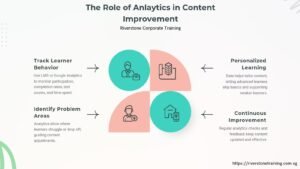
Data outside of the learning management system (LMS) is needed for Levels 3 and 4. Level 3 is demonstrating new knowledge and behaviours in the workplace, usually checked for by manager observation, performance review, or follow-up surveys. At level 4, the emphasis is on the connection between training and business results, such as fewer errors, increased sales performance, or shorter time to productivity. Furthermore, LMS analytics offer additional insights like completion rates, time on task, assessment scores, and module drop-offs, which can assist in pinpointing learner disengagement and/or challenges.
What Skills Are Needed for Effective E-Learning Content Development?
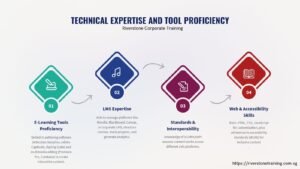
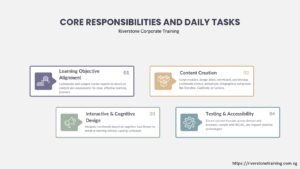
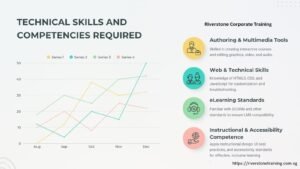
Creating effective e-learning content involves a range of instructional design, content, writing, visual design, and technical skills with authoring tools and learning management systems (LMS). These are the skills that are spread across different roles in the majority of organisations. Instructional designers work on the theory of learning and on structuring the curriculum; content writers are responsible for clarity and conciseness; graphic designers are responsible for visual assets and interface design; multimedia specialists produce video and audio assets; and LMS administrators are responsible for deployment and reporting.
Instructional designers and learning consultants may have one or more of these roles in organisations that do not have large internal teams, and they use rapid development tools like Articulate Storyline, Adobe Captivate or Rise 360 to perform this role. The structure can be arranged in any way, but the subject matter expertise is still crucial. The knowledge in e-learning course materials is important, and therefore, instructional designers collaborate with the subject matter expert from the beginning of the development of the course materials so that the knowledge they present to the students is instructional and correct.
Conclusion
The process of developing e-learning course content is so much more than just taking the same training content and digitizing it. It requires a well-defined process of development, built upon the principles of instructional design, understanding of the audience, learning objectives, and structured assessments. Effective e-learning content development combines content knowledge, learning science, technology, and ongoing assessment to create programmes that actually enhance knowledge and skills and job performance.
Learner engagement, content accuracy, interactive activities, and meaningful assessment are not an option, but rather a foundation of any effective e-learning programme. No matter if it’s onboarding, compliance, professional development, or technical training, the organisations that go to this level of rigour enjoy higher completion rates, better knowledge retention, and more impactful training to measure.
The following summary table captures the core principles for building effective e-learning course content:
| Principle | What It Involves | Why It Matters |
| Clear learning objectives | SMART outcomes relating to performance objectives | Provides a purpose and a measurable intent to content |
| Audience analysis | Recognizing the roles, knowledge, and contexts of learners | Knows how to make content relevant and appropriate to readers |
| Content sequencing | Logical module structure (simple to complex) | Encourages progressive learning and alleviates cognitive load |
| Interactive activities | Scenarios, simulations, quizzes, and branching | Rises involvement and enhances the use of knowledge |
| Multimedia design | Video, audio, animation, and visual elements | Encourages several different learning styles and enhances retention. |
| Formative assessment | Knowledge Check questions are incorporated into the content throughout its organization. | Reinforces learning and identifies gaps in real time |
| Summative assessment | Assessment with objectives at the end of the course | Measures whether learning outcomes have been achieved |
| LMS deployment and tracking | Course delivery, analytics, and completion records | Allows for reporting, compliance checking, and improvement |
| Evaluation and iteration | Kirkpatrick-level review of training effectiveness | Promotes ongoing development of training results |
As an instructional designer, trainer, HR, or a course developer, the lesson you’ll learn from this is the following: the quality of an e-learning programme starts before the first screen is created. Take the time to think through objectives, analyze your audience, and plan your content, and the development process will be greatly streamlined and the results highly informative.