Business training problems are addressed by custom e-learning content that will help you create learning experiences that are designed to meet the needs and goals of your employees and help you deliver scalable training across your organization. By collaborating with an e-learning content development company, companies can create training programs that cater to their particular staff and business requirements, rather than relying on generic content.
What Is Custom E-Learning Content?
Custom e-learning content is training content created with an organization’s processes, terminology and business goals, not adapted from a generic course library. It usually includes customized scenarios, brand-specific images and evaluations that mirror the actual situations and difficulties encountered by workers in real-life situations. It is designed with a purpose and is able to address specific skills that are not covered in off-the-shelf materials.
Organizations partner with an e-learning content development company to translate internal knowledge, compliance requirements, and workplace scenarios into structured digital courses. In this collaboration, you will usually have someone from the business who knows the content of your course and an individual with instructional design experience from the development team.
Why Do Businesses Choose Custom E-Learning Instead of Off-the-Shelf Courses?
The reason businesses opt for custom e-learning is that it is difficult to find courses that align to their business processes, tools, and terminology, meaning that the knowledge that employees gain has less direct applicability to their work. Custom content enables an organization to integrate its own systems, case studies and compliance requirements into training, making it immediately relevant. This is a quality that frequently makes the difference between training that changes behavior and just “training done.
There is still merit in off-the-shelf courses for broad-based, non-specialized skill areas, but more and more organisations are custom developing courses to tie to performance, compliance or competitive advantage. This selective approach allows L&D teams to target development efforts where they’re needed.
How Does Custom E-Learning Solve Workplace Training Challenges?
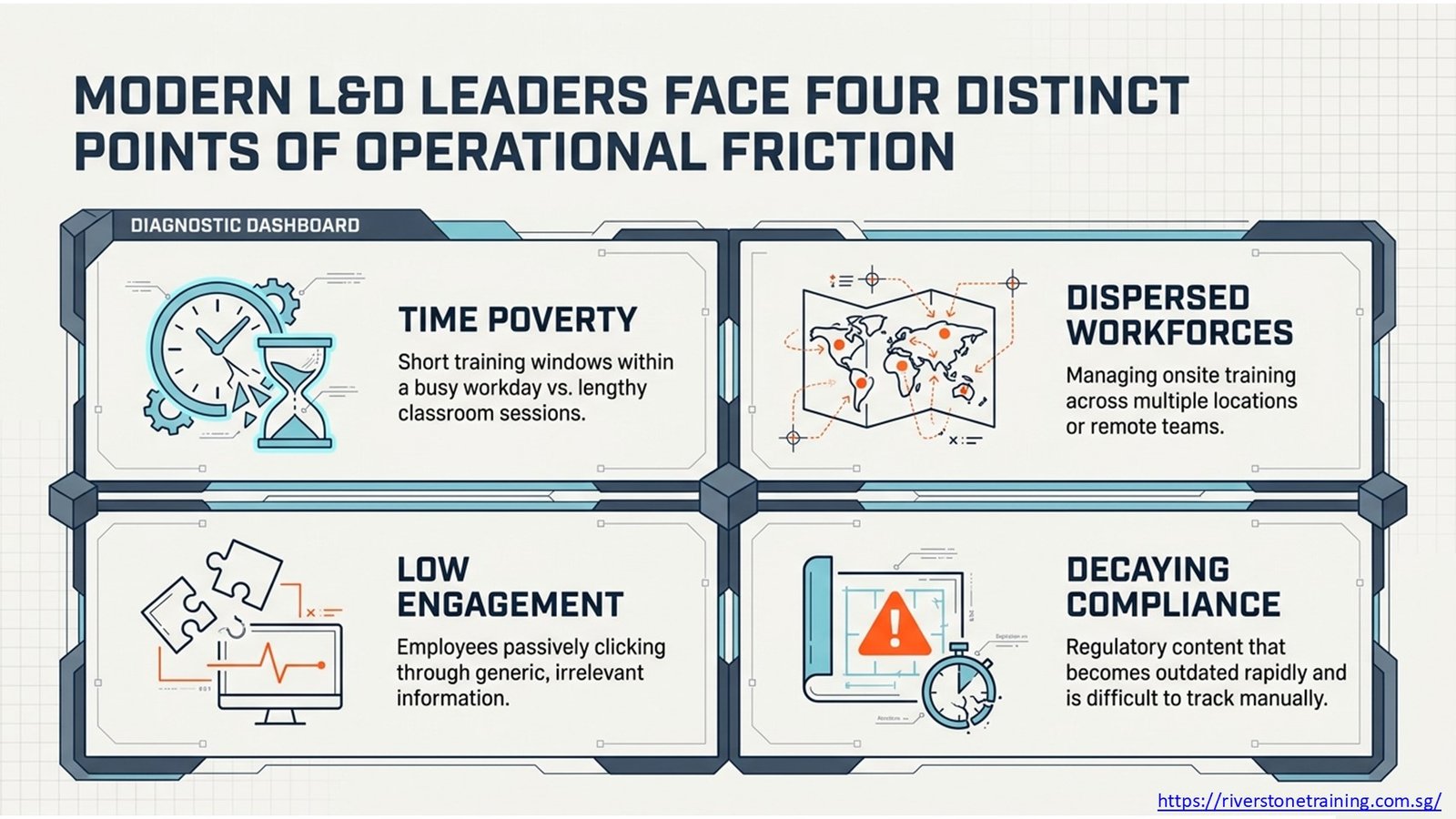
Custom e-learning tackles issues of workplace training by providing digital learning materials for employees that happen consistently and in a structured fashion across the entire organization, irrespective of location or shift. It also addresses time constraints by offering micro-learning formats, which fit into the limited time available in a workday, but not necessarily a lengthy classroom session. Both are prevalent in industries with dispersed staff members and short training sessions.
Custom e-learning is especially beneficial for businesses with several locations or teams working remotely, eliminating the need for managers to manage onsite training from multiple locations. This uniformity is especially beneficial for compliance training, where all personnel need to be given the same information in a similar manner.
Business Training Challenges
| Challenge | Custom E-Learning Solution |
| Inconsistent training | Standardized digital learning |
| Low employee engagement | Interactive learning activities |
| Limited training time | Microlearning modules |
| Multiple office locations | Centralized online delivery |
| Outdated compliance content | Rapidly updatable digital courses |
How Does an E-Learning Content Development Company Design Effective Courses?
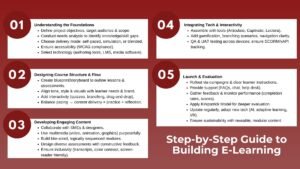
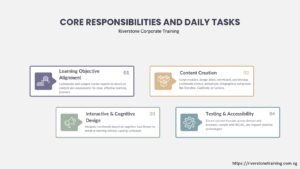
An e-learning content development company follows a structured process to create effective courses, which include establishing learning goals, audience, and behavior change before any content is developed. Instead of using a single format, designers choose the format for the content, whether it be scenario-based modules, video, or interactive simulations. This process ensures that the end product is a course that contributes to a business outcome and not just information.
Normally, development involves a storyboard, multimedia production, and review by subject matter experts to verify accuracy before the course is created in its final format. This is what makes professionally created eLearning different from hastily put together slide presentations.
Why Is Needs Analysis Important Before Developing Training?
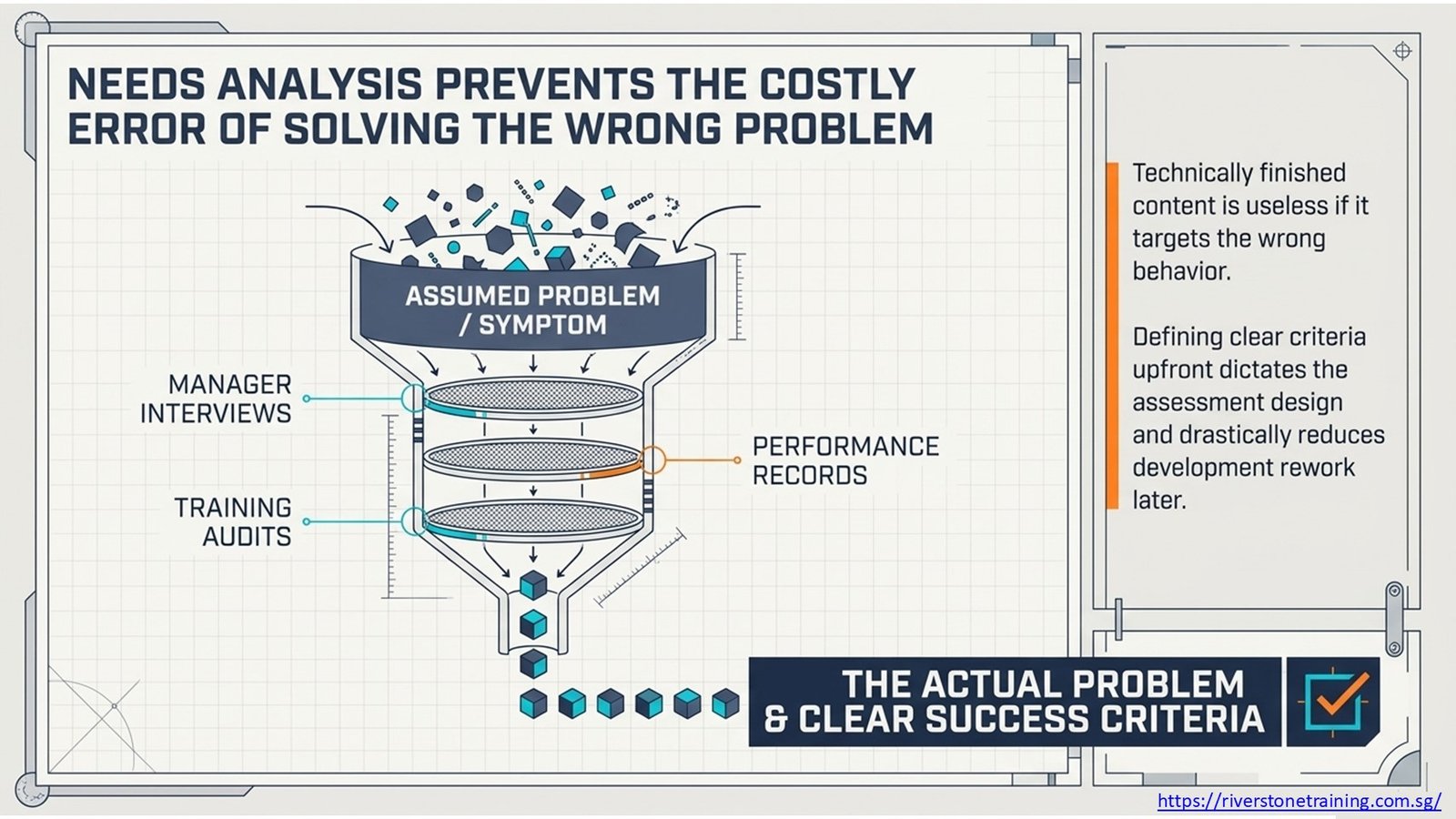
The value of needs analysis is that it targets the actual problem that a course must solve, which avoids organisations creating a training that solves the wrong problem. This usually includes interviews with managers and employees, examination of performance records, and an audit of current training resources to gauge training needs and deficiencies. Often content is technically finished without this step and thus does not affect on-the-job behavior.
A good needs analysis also lets instructional designers know what “success” will be in their course, which means they will have a clear set of criteria for designing assessments and determining if the course they have created fulfills the identified need. The investment here pays off in terms of the amount of rework later in development.
How Does LMS Content Development Improve Learning Delivery?
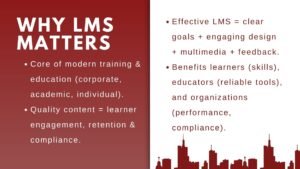
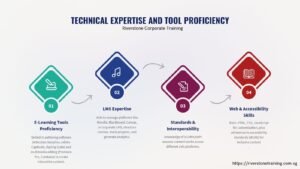
LMS Content Development enhances learning delivery by organizing learning content that is easily embedded in the tracking, reporting, and assessment tools of a Learning Management System, which allows learners to access learning content easily and administrators to monitor progress. Well-structured LMS content enables functionalities such as tracking who has completed the training, sending notifications when the training is due, and even providing certifications. These features are difficult to replicate in manual training delivery. This is particularly useful for compliance training, as it may be required to be completed in order to meet regulatory requirements.
Effective LMS content development also ensures courses are built to be maintained and updated efficiently within the platform, rather than requiring a full rebuild each time information changes. Well-designed content planning for organizations makes it easier to scale up training to new employees, new locations, and changing compliance regulations.
LMS Features and Benefits
| Feature | Benefit |
| Progress Tracking | Monitor learner completion |
| Assessments | Measure understanding |
| Reporting Dashboard | Evaluate training outcomes |
| Mobile Access | Learn anytime, anywhere |
| Certification Records | Support compliance documentation |
How Can Interactive Learning Improve Employee Engagement?
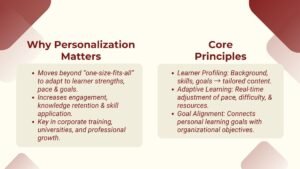
Interactive learning is a method that makes employees make decisions, simulate learning, and complete interactive tests to stimulate their participation and response to learning rather than watching or reading. This involvement helps to maintain student engagement during the duration of a course and provides instant feedback on what the student has learned. Interactive features also help to give an indication of where learners are having problems before they get to the higher level.
These include branching scenarios, drag-and-drop activities, and multiple-choice and true/false quizzes that are spread throughout a course and not just at the end. They are well suited to skills training, where the application of knowledge in context is more important than just remembering facts.
How Does Scenario-Based Learning Improve Knowledge Retention?
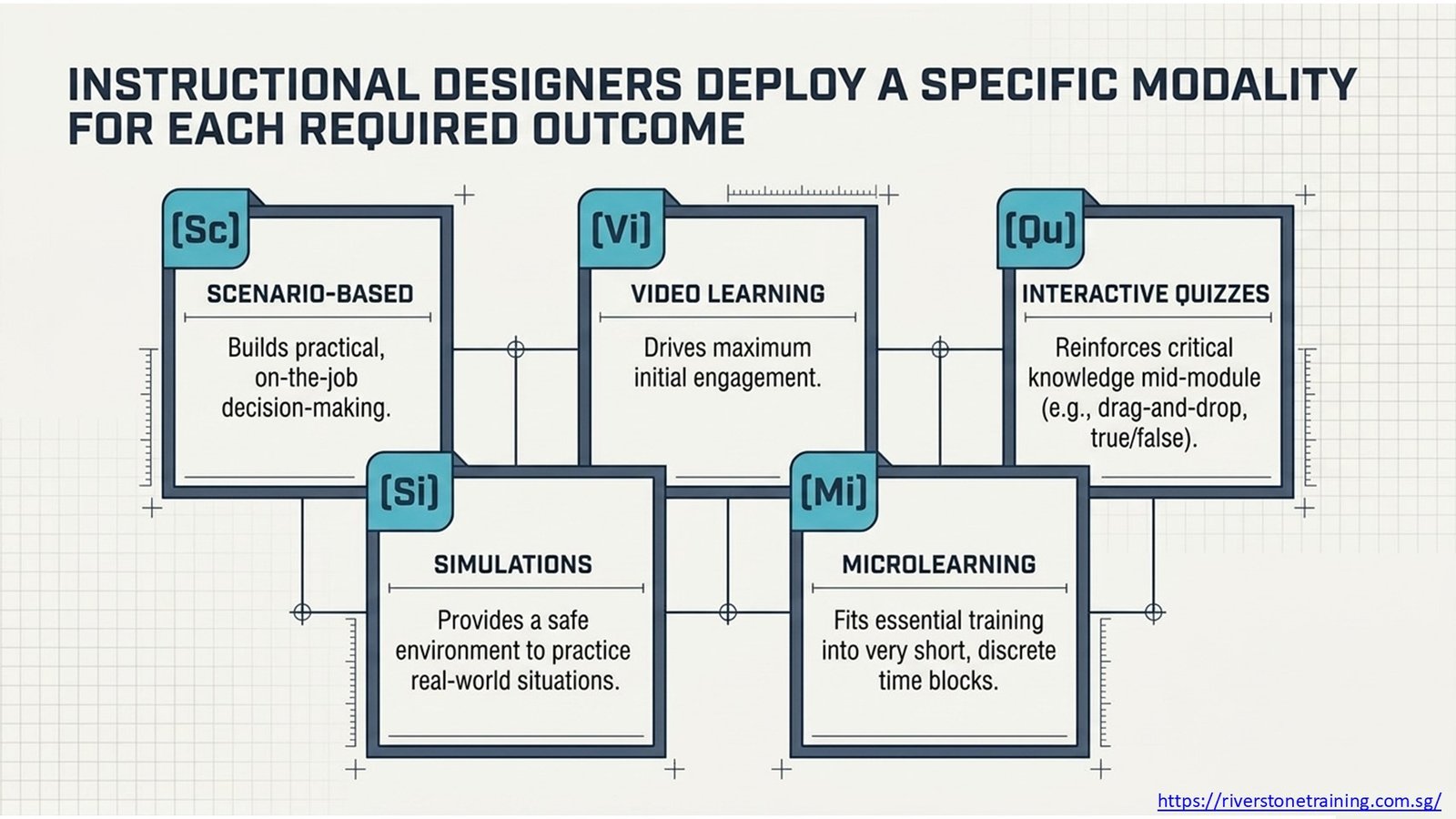
The scenario approach to learning helps to retain knowledge because, instead of just memorizing information, placing employees in a realistic environment allows them to apply their knowledge in making a decision. This approach allows the training to reflect the way employees will apply it on the job, and enhances the relevance between the training course and actual performance. Numerous studies have demonstrated that recall from applied practice is more effective than recall from content review.
For instance, in a customer service course, a difficult customer scenario might be followed by a question asking what the best response to the situation is, and then the questioner asks why that is the best response. The kind of applied practice is hard to replicate into generic, off-the-shelf training content.
Learning Design Approaches
| Design Method | Purpose |
| Scenario-Based Learning | Build practical decision-making |
| Video Learning | Improve engagement |
| Interactive Quizzes | Reinforce knowledge |
| Simulations | Practice real-world situations |
| Microlearning | Fit training into short time blocks |
How Can Organizations Deliver Consistent Training Across Multiple Locations?
Organizations provide uniform training to employees at various sites by storing training course materials in an LMS, and thus, providing them with the same content, assessments, and tracking of their completion. This eliminates the subjectivity that could result from using local managers or trainers to provide the content. Centralized delivery also simplifies the update of training, such that when training is updated in one place, it is reflected throughout immediately.
In the case of organizations that have teams across the globe, custom e-learning can also be customized for language and regional compliance requirements without altering the focus of learning or structure. Standardization and localization are two elements that are considered by many designers of multi-location training programs.
How Does Custom E-Learning Support Compliance and Regulatory Training?
Compliance and regulatory training is facilitated through custom e-learning, where courses cover the organization’s policies and specific regulatory requirements, and the LMS tracks when the training is completed for audits. In sectors like finance, healthcare, and manufacturing, where regulators may mandate that workers receive specific training and certification within a set period, it is crucial to have records showing that the training was actually completed. In certain industries like finance, healthcare, or manufacturing, where there may be regulatory requirements for specific training and certification within a certain timeframe, it’s important to have documentation of the training’s completion. Manual tracking is eliminated, cutting down on administration for large-scale teams.
The ability to update compliance training in real-time on content change also comes with the benefits of custom content. This flexibility allows organizations to remain up-to-date with new regulatory changes without having to train for outdated rules.
How Can Learning Analytics Improve Training Effectiveness?
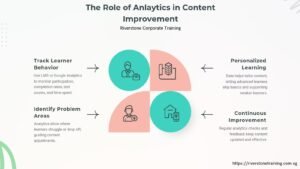
Learning analytics can provide the answer as to where a learner gets stuck, how much time they spend on certain sections, and how scores on assessments compare between teams or locations to enhance training effectiveness. This information enables L&D teams to pinpoint areas in a course that need improvement, and then adjust them to reflect what the evidence shows is broken, not what they think is broken. Analytics also can show how training is impacting the business by linking course completion and performance to other organizational metrics.
Completion rates, assessment results, and engagement trends reported on dashboards provide training managers with a solid snapshot of program health without having to manually review individual learner records. This visibility helps to make better decisions on the investment of further development resources.
What Common Mistakes Should Organizations Avoid?
Common pitfalls include developing content around the information to be delivered, not conducting a needs analysis, but jumping straight to content development. Other times, organizations add too much information to courses, and the result is that some people finish the course but do not retain the information. Both errors lead to training which is technically possible but is not effective in changing training behavior.
Another one of the common pitfalls is assuming that a course is complete once it has been published, without taking time to analyse the data and student feedback to adjust it over time. Even a carefully planned course can become obsolete or irrelevant if it is not continually reviewed.
How Do E-Learning Projects Support Business Growth?
E-learning projects promote business development by expanding employee development in a scalable way as companies hire more staff, relocate to new locations, or launch new products and/or processes. Once built, custom training can be rolled out as needed to a larger, more diverse workforce, without the expense and schedule of multiple in-person training sessions. This scalability is especially beneficial in times of quick hire-ups or expansion.
Good training also improves the rate at which new hires reach full productivity; structured onboarding content minimizes the variability in the training that occurs when the new hire is on the job, which is often dependent upon the manager. This direct correlation of training quality and time-to-productivity is one of the main reasons why organisations are continuing to invest in custom e-learning as they grow.
Why Is Continuous Content Improvement Important?
This is because, over time, business processes, compliance regulations and employee needs evolve, and training that isn’t updated over time becomes less accurate and relevant. By periodically checking learning analytics and feedback from learners, you can see which parts of a course need to be amended before they create a gap. This continuous support is much cheaper than starting a new course from scratch based on an old one.
Institutions that view e-learning as a living learning programme, and not a project, are likely to enjoy better long-term engagement and more regularity in ensuring that training programs match what the business needs.
How Can Organizations Build a Long-Term Digital Learning Strategy?
Organizations develop a long-term approach to digital learning by connecting training investments with business goals, setting up a regular cycle of needs analysis and content creation, and leveraging learning analytics for continuous improvements. That implies thinking of e-learning as a developing ability, not a collection of disjointed course projects. A clear strategy also enables L&D teams to prioritize which training programmes will provide the biggest business impact.
When working with skilled instructional designers and through the use of a well-structured LMS, organizations can maintain the infrastructure necessary to expand this approach over time, from onboarding to compliance to leadership development – all within a single learning framework.
Summary: How Custom E-Learning Improves Training Outcomes
| Objective | Business Benefit |
| Higher Engagement | Better course completion |
| Improved Knowledge Retention | Stronger job performance |
| Consistent Learning | Standardized workforce capability |
| Continuous Improvement | Better organizational performance |
| Scalable Delivery | Efficient training across growth and change |
Conclusion
Custom e-learning content is the solution to business training problems, providing the ability to create learning programs that are more engaging, scalable, and aligned with the specific needs and objectives of the business. This needs to be accomplished in a thoughtful manner through interactive and scenario-based learning, careful needs analysis, and technology that can monitor and facilitate the learning process at scale.
An e-learning content development company designs digital learning content solutions that are specific to the organization’s problems, while good LMS content development guarantees that those courses are sent and tracked and are consistently refined using a well-executed Learning Management System. By investing in customized e-learning solutions, organizations can ensure a more seamless journey towards sustaining their workforce capabilities in the digital age, achieving higher