Regulated Industry Compliance E-Learning
Compliance in regulated industries is about establishing that employees understand, embrace and comply with the regulations that apply to their industry. Whether it is the bank that is compliant with its anti-money laundering responsibilities, the pharmaceutical company that is compliant with its good manufacturing practice, or the energy company that is compliant with its environmental safety standards, compliance is never a “tick the box” exercise. It is a part of everyday business operations, with significant financial, legal and reputational risks if something goes wrong.
But the traditional methods of compliance training – classroom-based instruction, hard-copy manuals and annual refresher talks – have been the wrong fit for the realities of today’s international organisations. Employees are spread across geographies and time zones, rules and regulations are continually evolving, and the amount of compliance training required can be a nightmare for both the learner and the compliance manager. That’s where compliance training e-learning has made the difference, revolutionising how regulated organisations create a culture of compliance.
In this article, we’ll take a look at the evolution of compliance and regulatory awareness e-learning, what every junior to middle-level professional should know about this field, and why properly designed e-learning content services for corporate training are now deemed as critical infrastructure in regulated industries.
Why Regulated Industries Demand a Different Approach to Compliance Training
When it comes to compliance training, all training is not equal. While an employee in a retail store memorising store policy and a trader in the derivatives market memorising market conduct rules are each undertaking “compliance training”, the risks, the level of understanding and the regulatory expectations are not the same. For regulated companies, the stakes of poorly trained employees are much more than just getting fired. They can lead to regulatory fines, loss of licence, class-action lawsuits and an irreparable loss of trust.
The table below shows the areas of compliance focus in some of the major regulated industries. It’s essential to understand your industry’s framework in order to build an effective learning plan.
Table 1: Regulated Industries and Their Compliance Training Focus
| Industry | Key Regulatory Body / Framework | Primary Compliance Focus |
| Financial Services | MAS, SEC, Basel III, FATF | AML, KYC, data protection |
| Healthcare & Pharma | FDA, WHO GMP, HIPAA | Patient safety, clinical ethics |
| Energy & Utilities | NERC, ISO 14001, OSHA | Environmental safety protocols |
| Aviation & Transport | ICAO, FAA, IATA | Safety culture, incident reporting |
| Technology & Telecoms | GDPR, PDPA, ISO 27001 | Data privacy, cybersecurity |
The challenge with compliance in these industries is regulatory knowledge and behavioural expectations. It’s not sufficient for an individual to know they must ensure data is secure under the GDPR; a financial adviser must know how they must do this in their particular job (e.g., how to deal with client data in emails; how to respond to a potential breach within 72 hours). So compliance and regulatory awareness training must marry theory and practice, which is where a well-designed e-learning experience shines.
Early career professionals in the regulated sector may not appreciate the regulatory intensity of their environment. A newly hired bank analyst at an international institution may need to complete more than 15 initial training courses before working with clients. A newly-appointed pharmacovigilance associate may have to be proficient in several international reporting regulations. Gearing up early to this reality – and considering compliance training e-learning as an opportunity for personal professional development rather than a compliance exercise – is a key distinction between top performers and the rest.
The Shift to E-Learning: What Changed and Why
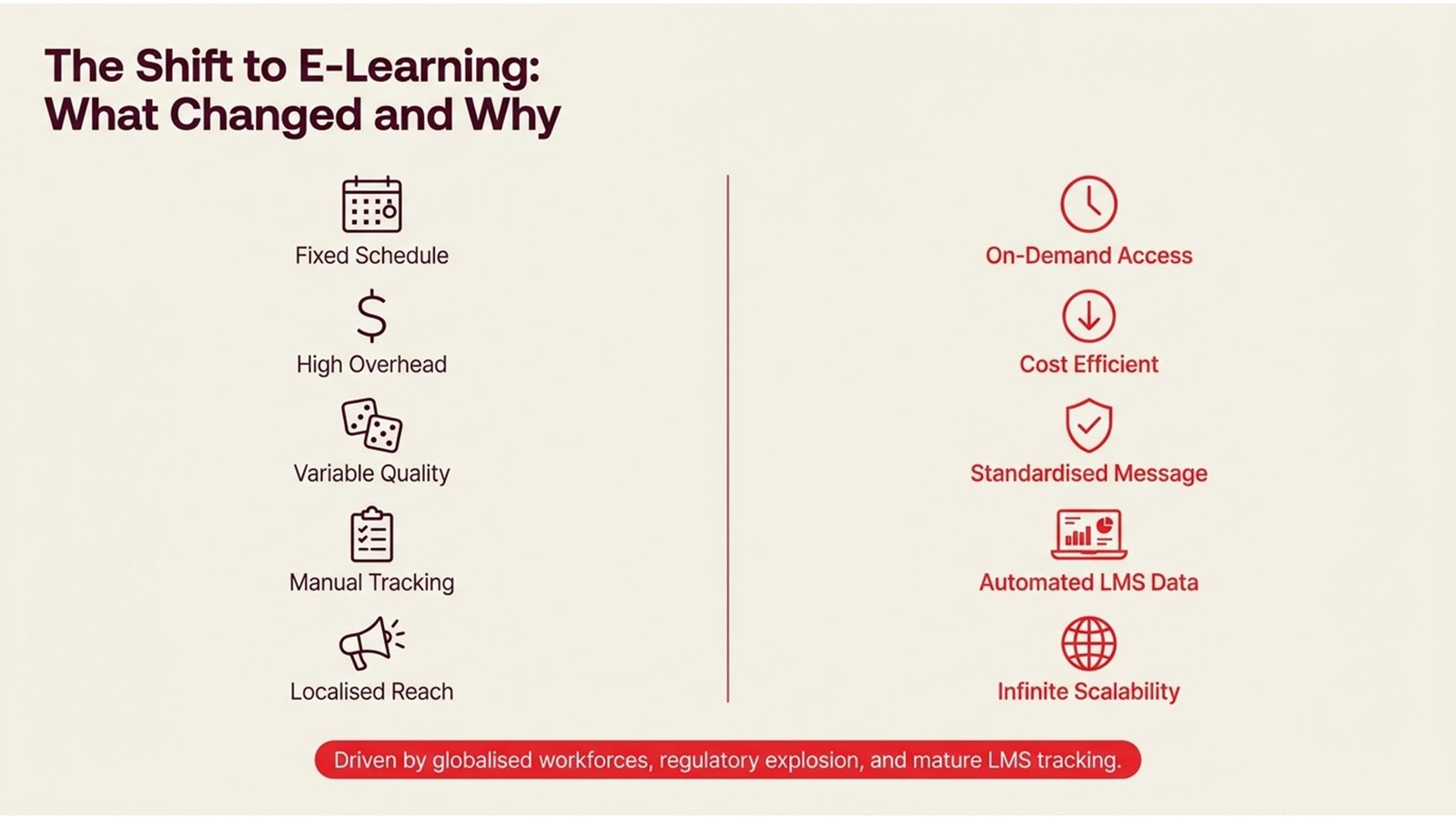
The use of digital learning in compliance-intensive industries took off in the early 2010s for three key reasons: the surge in regulatory frameworks after the global financial crisis of 2008, the globalisation of corporate talent, and the evolution of the learning management system (LMS), which could log completion and assessment of large populations. An innovative teaching model became a business imperative.
A comparison of classroom and compliance training e-learning demonstrates the differences. The table below lists some of the differences that have led to the move to digital.
Table 2: Traditional Classroom vs Compliance E-Learning — Key Differences
| Feature | Traditional Classroom | E-Learning |
| Delivery | Fixed schedule, in-person | On-demand, anytime access |
| Cost | High (venue, trainer fees) | Lower at scale |
| Consistency | Variable by trainer | Standardised across the workforce |
| Tracking | Manual sign-in sheets | LMS automated reporting |
| Updates | Requires a new session | Module updated centrally |
| Scalability | Limited by venue/trainer | Unlimited learners globally |
One notable example of this is Deutsche Bank’s global roll-out of digital anti-money laundering (AML) training in the mid 2010s following an increase in regulatory focus. The bank was faced with delivering training to tens of thousands of staff across 50+ countries and changed its approach to centralised e-learning content. The solution enabled language variations but a uniform regulatory message, and it was possible to provide reports of who had completed the training for regulatory submission in hours rather than weeks. The result was a successful use of both the scalability of e-learning content services for corporate training and the audit trail features as evidence in regulatory inspections.
Likewise, in the pharmaceutical industry, multinational corporations like AstraZeneca and Johnson & Johnson have invested in digital learning platforms to support Good Clinical Practice (GCP) and Good Manufacturing Practice (GMP) training at their research and manufacturing facilities. These offerings are refreshed in near-real time when new regulatory guidance is released, and so all sites are always up-to-date on compliance issues – something that would be impossible to achieve with classroom-based training.
Five Key Steps to Building Effective Compliance E-Learning Programmes
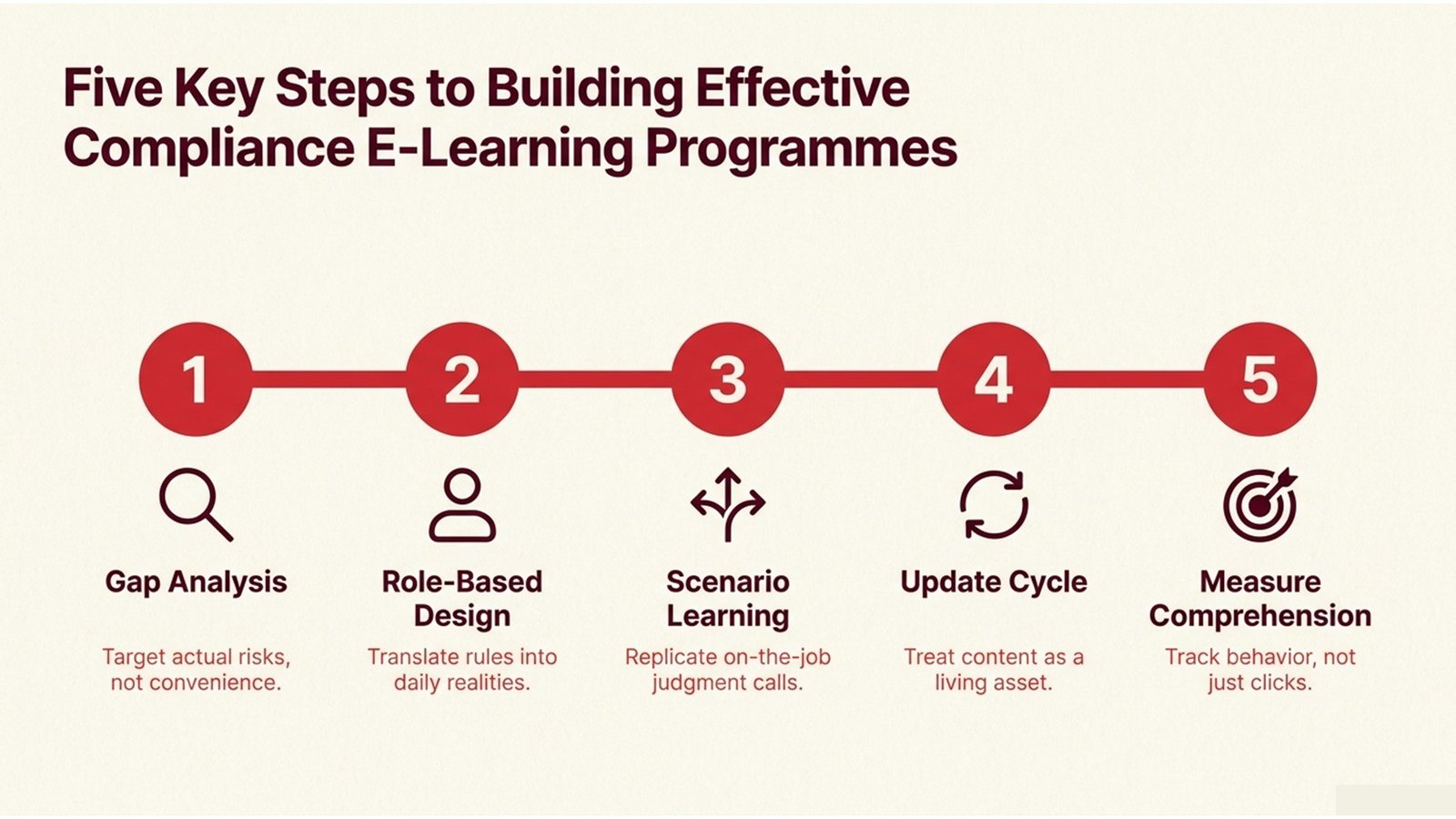
For those involved in designing and/or commissioning compliance training e-learning (either as part of a company or external to the company), it’s important to understand how these programmes are developed. The following is a process flow of how regulated organisations develop and manage their e-learning.
Table 3: Process Flow — Building a Compliance E-Learning Module
| Stage | Activities | Key Stakeholders | Output |
| 1. Needs Analysis | Gaps in regulations, profile the target audience | HR, Legal, Compliance Officer | Training needs report |
| 2. Content Design | Create learning objectives, scenario mapping | Instructional Designer, SME | Storyboard/content outline |
| 3. Development | Develop the modules, assessments, voice over | E-learning Developer, Learning & Development | SCORM/xAPI module |
| 4. Review & QA | Legal, pilot learners | Compliance, Legal, Pilot Learners | Sign-off & revision log |
| 5. Deployment | Load in, assign to learners | LMS Admin, IT, HR | Live course, completion tracking |
| 6. Review Cycle | Track completion, do an update check | Compliance Officer, L&D Lead | New module, audit report |
Based on this approach, five principles emerge to guide compliance e-learning in regulated environments.
- Start with a Regulatory Gap Analysis. Prior to any content being authored, compliance and L&D professionals should compare current training content to regulatory requirements. What’s new in the past 12 months? What jobs have the greatest risk exposure? Which areas are lacking in knowledge based on audit or incident findings? This ensures training is not structured around the ease of the organisation, but based on risks.
- Write for the Role, Not the Regulation. A common pitfall in regulatory and compliance training is to lift the verbiage out of the law and then serve it up as an e-learning course. Good e-learning uses regulatory text to create scenarios that are relevant to the learners’ work. A sanctions screening scenario-based exercise for a trade finance officer will not be the same as one for a retail banking agent – even though they are both based on the same regulatory requirements.
- Use Scenario-Based Learning and Realistic Assessments. It’s well known that in compliance training, learners will remember information much better if they see it in the context of a decision-making scenario. Instead of asking “What are the consequences for not reporting a suspicious transaction?”, a good module might ask the learner to consider a case study in which they are asked to process a suspicious transaction, and must decide what to do – just like they will in the workplace.
- Build in a Review and Update Cycle. Corporate e-learning content services need to have a program for content review. In highly regulated industries, the regulatory requirements are changing, guidance on how the regulations are being enforced is shifting and policies are being updated. A compliance module developed in 2022 may well be out of date in 2025. If organisations approach e-learning as a product, rather than a resource, the risk is training staff on the wrong requirements, which could leave them open to regulatory enforcement.
- Track Completion, but Measure Comprehension. It’s easy to report, using learning management systems, that 98% of employees have completed their mandatory training. But regulators are more and more focused on comprehension and behaviour change. Increasingly, forward-looking organisations are designing their assessment to require thinking through scenarios, minimum passing scores, and a limit on the number of attempts, and post-training surveys to determine whether training has been applied on the job.
Common Challenges and Lessons from the Field
Even in organisations with considerable resources, there are many challenges in deploying large-scale compliance training e-learning. Knowing these problems in advance is particularly helpful for those embarking on careers in L&D, compliance and HR in regulated industries.
Perhaps the most common is content fatigue. When each department of the company creates its own compliance content – legal, HR, IT security, finance, operations – the learner is easily fatigued. An average manager in a large insurance company may be required to complete 30 or more courses. Overload leads to “click-through” learning – a defeat of the purpose of compliance and regulatory awareness training. The takeout from this is that quality, not quantity, matters. Companies with a regular audit process for rationalisation (whether the module makes compliance risk lower) have much higher engagement.
The second issue is the disconnect between the completion of e-learning and behaviour change. One recent example involved a global bank that spent considerable time and effort in compliance training e-learning for its front-office personnel on conflicts of interest, only to be subjected to regulatory enforcement for the issues on which it was trained. The subsequent investigation revealed that although compliance with the e-learning had been almost 100%, the e-learning had failed to link to the products and clients that those employees dealt with. The regulatory take-out was clear: off-the-shelf training, even if top-notch, can’t replace specific compliance and regulatory awareness training that relates to the risks associated with the learner’s job.
A third issue is the technology infrastructure, especially for organisations operating in a multi-jurisdictional environment with different IT environments. SCORM-compatible content that works fine in one regional learning management system (LMS) may not work in another. Slow bandwidth in some jurisdictions may negate the use of video-rich content. Corporate training e-learning professionals must ensure their e-learning content service provider has implemented rigorous testing across platforms and can create e-learning in a format suitable for low-bandwidth markets, such as mobile-first or offline accessible e-learning modules.
The Governance Framework: Making E-Learning Audit-Ready
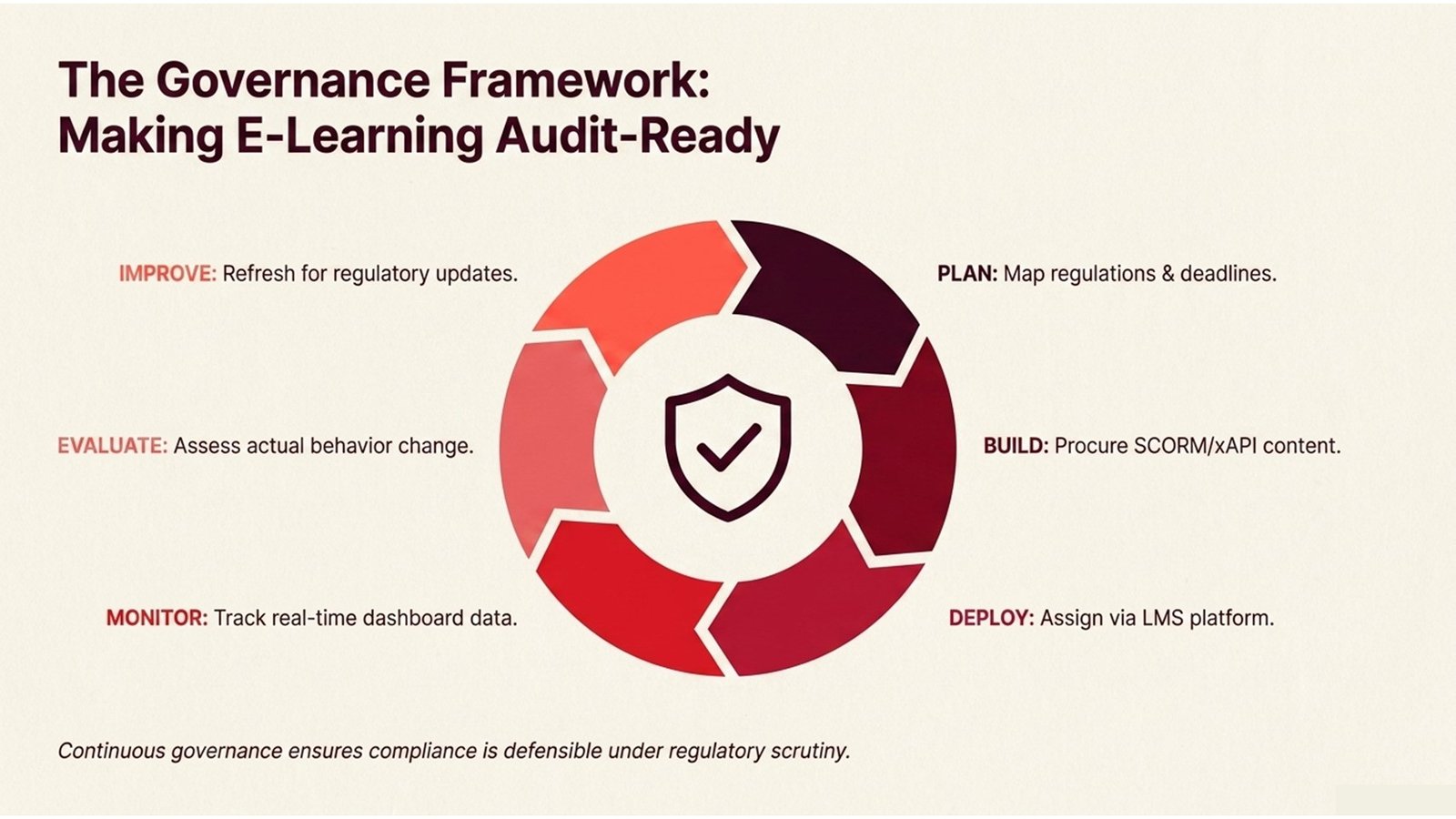
In regulated sectors, compliance training e-learning is a governance tool, as well as a training medium. As regulators demand more and more evidence that employees have been trained in the relevant rules and regulations, organisations need to be able to provide such evidence. This means that the reporting, tracking, and archiving of training, as much as the learning content, are as critical as the development of the content.
The governance cycle below offers a helpful guide for junior to mid-level compliance and L&D professionals to ensure that their e-learning training is “audit-ready”.
Table 4: Compliance E-Learning Governance Cycle
| Phase | Actions | Success Indicator |
| Plan | Link regulation to roles in the organisation; establish deadlines | Regulatory coverage matrix approved |
| Build | Create or source e-learning content services for employees | Modules are SCORM/xAPI compliant |
| Deploy | Use LMS to assign; set deadlines | 90%+ enrolment within 2 weeks |
| Monitor | See who has completed, quiz results, and drop-off rates | Real-time dashboard reports |
| Evaluate | Evaluate behaviour change; seek feedback | Kirkpatrick Level 3 & 4 data |
| Improve | Update content to meet new regulations; fill in gaps | Decrease in compliance incidents YoY |
One example of how this type of governance approach works comes from the airline industry. In the early 2010s, after several safety issues were at least in part blamed on variable crew resource management training, major airlines revamped their online training systems to adhere to the governance cycle above. By centralising their L&D systems (LMS) and enabling automatic escalations if deadlines were not met and by linking the training records to their safety systems, the airlines were able to demonstrate to regulators not only that training had been completed, but that it had been reviewed, verified, and connected to safety performance.
Those looking to work in compliance, L&D or regulatory affairs in a regulated industry should recognise that the skills to articulate and manage this governance cycle are very valuable. They are not seeking people who can merely complete online training – they want people who can build systems to make compliance and regulatory awareness training defensible in the eyes of the regulators. This includes proficiency in LMS reporting, how completion reports align to regulatory evidence needs, and when to bring gaps to the attention of senior management.
Selecting the right e-learning content services for corporate training is also a governance issue. Companies need to ensure a provider’s content is compatible with the technical specifications (SCORM 1.2, SCORM 2004, or xAPI) of their LMS, that content can be branded and tailored to align with their policies, and that the provider has experience with the specific regulatory schemes they need to address. Research into content providers is not just “housekeeping” – it’s a critical element of a compliance training governance policy.
Conclusion: Actionable Insights for Compliance Professionals
The emergence of compliance training e-learning in regulated industries is one of the largest changes in how organisations manage regulatory risk from a human perspective. What used to be a logistical problem (how do you ensure a group of people are in a training session) is now an information design problem: how do you design digital learning experiences that change behaviour, meet regulatory requirements, and are relevant and rigorous across multiple geographical, cultural, and language contexts?
For entry to mid-level professionals working in this field, there are some lessons to be taken away. First, know your regulatory environment before embarking on training design or evaluation. Training in regulatory awareness and compliance, which doesn’t start with an understanding of the regulatory landscape, will never hit its mark. Second, make the case for less, but better, mandatory training for your organisation. I would much prefer to use the word “can” than “must” or “have to”.
Third, learn how to use and interpret the data from learning management systems. In highly regulated industries, having the ability to run a clean completion report and being able to explain what it means and what it doesn’t mean in terms of compliance is a skill that will set you apart from your peers and regulators alike. Fourth, when sourcing e-learning content services for corporate training, look for companies that understand your industry’s regulatory environment, as well as being able to design learning experiences. The best compliance e-learning has both.
Finally, view compliance training as an organism that needs to be nurtured and monitored, not a product to be “delivered”. Risk, regulatory requirements, priorities, and human resources are in constant change. Training organisations in a culture of continuous improvement of compliance training e-learning, rather than maintenance, is the sign of organisations that proactively meet regulatory challenges, rather than being reactive. For those who learn this early on, the value of their talents to any regulated organisation will be undeniable.