The use of AI in e-learning isn’t the future; it’s already happening in creating course content, customising learning paths, evaluating and generating learning materials. Where it really accelerates development is the more relevant question for L&D leaders, not whether or not to use it.

How Is AI Being Used in E-Learning?
In corporate training and financial education, AI has shifted from experimentation to becoming an integral part of the content creation process. It’s present in almost every form, from the initial course outline to the analytics which determine if learners absorbed it. The following sections summarise the current contributions of AI.
Content Drafting
AI in the form of a drafting assistant is the most mature capability. It can aid the developer in creating the initial outline of content, suggesting learning objectives, starting drafts of instructional text, and recommending “summaries of the course, scenario ideas, and questions for a quiz or knowledge check. The fact is that this is helpful for teams that have to churn out a lot of content in a timely manner, but none of the AI-generated drafts can be truly called accurate, in tone, or even if it actually communicates the concept that it’s supposed to explain.
Personalisation
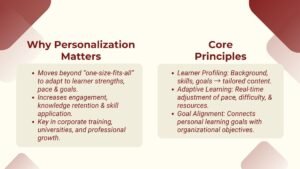
One of the most promising uses of AI e-learning tools is personalisation. AI can be used to provide adaptive content, various levels of difficulty, progressions and suggestions for content, and personalisation of feedback. But personalisation is only as effective as the information that fuels it: poor data, an underdeveloped platform or shallow design will deliver recommendations that are “personalised” but not truly useful to the learner.
Assessment Creation
AI can help create assessments at scale, including multiple-choice, scenario-based, knowledge checks, practice exercises and variations of questions — one of the more time-consuming aspects of course development. There is a potential danger that with AI-generated questions, one might be able to recall a fact instead of meeting the learning objective. That is not to say we need to ensure that an instructional designer verifies that each question assesses the course’s intended content and not whether the learner can remember a term.
Translation
AI can help paint pictures faster, translate course content and materials, and generate first-draft multilingual content—including adapting terminology market to market. It is a lot quicker than a complete manual translation procedure. However, certain nuances, like the use of cultural context, industry-specific jargon or tone, can add a valuable human touch, as a translation that is technically correct might fall short for a specific audience or geographic region.
Voice and Video
In media content creation, AI is increasingly utilised for voiceovers, narration, video scripts, captions, video transcripts and even avatar learning content. It significantly decreases the workload in the creation of courses that are media-intensive. It doesn’t do this automatically, but it does ensure that a video is not an uninstructive video; there are other decisions that a script generator cannot make.
Learning Analytics
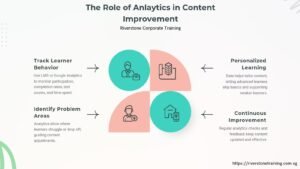
Learner data can be analysed with AI to identify patterns of completion, assessment performance, trends in engagement, and content that is underperforming. This is useful, but valuable and meaningful distinction between collecting this data and making good use of it. It is only helpful to identify that it is a problem with a module if someone with instructional judgment decides on what to do about it.
What Can AI Do Well?
The most obvious benefits of AI in e-learning content creation are in high-volume and repetitive tasks, such as creating initial drafts, generating content and question variations, summarising content, aiding in translation, drafting multimedia scripts and helping with customisation. These are things that used to take a lot of a content developer’s time. By handing over the work to AI, instructional designers can focus more on decisions that matter most: course sequence, relevance, and course assessment design.
AI isn’t, however, a replacement for the entire development process. It can produce a lot of raw material in a short amount of time, but someone still needs to be able to determine what to include in the course, the order in which it should be presented and whether it will really benefit those for whom it was created.
| AI Capability | Potential E-Learning Application |
| Text generation | Draft course materials |
| Question generation | Create knowledge checks |
| Translation | Develop multilingual drafts |
| Generative AI | Produce content variations |
| Voice generation | Create narration |
| Analytics | Identify learner patterns |
What Should Human Instructional Designers Still Control?
One of the most critical differences in the entire discussion is that it’s not creating content; it’s creating learning. While AI can generate a technically correct explanation of nearly any topic, good instruction involves making a judgment about the learner, rather than making only a correctness judgment about the topic.
Human instructional designers should still be responsible for owning the learning objectives, the instructional strategy, the structure of the curriculum, the accuracy validation, the context, the pedagogical decisions, the quality of the assessment, the needs of the learner, the emotional and cultural considerations, the compliance requirements, and final approval of content.
Consider, for instance, one of the financial concepts. AI can produce a correct description of, for example, discounted cash flow analysis. However, the job of an instructional designer is still to determine who needs to learn it, what he or she should know before he or she reads it, what he or she should be able to do after reading it, what example will make it relevant to his or her real world job, what activity he or she will use to practice it, and how his or her understanding will be measured. None of these is solved with the technically proper answer.
| Task | Best Handled By |
| Producing first-draft explanations | AI, with human review |
| Deciding what learners must be able to do | Instructional designer |
| Generating question variations | AI, validated by SME |
| Sequencing content for cognitive load | Instructional designer |
| Drafting multilingual content | AI, checked for localisation |
| Approving content for publication | Human reviewer / SME |
Risks of Using AI for E-Learning Content
Organisations need to thoroughly review the AI-generated content prior to publication and deployment to ensure it aligns with existing risk areas. All of these are valid considerations for not using AI in e-learning, but they are valid considerations for using AI as a tool to create a review, not finished content.
Accuracy
AI-generated content may contain inaccuracies, out-of-date or fabricated information, and improper explanations or examples. This risk is greatest in specific subject areas, such as finance, compliance, healthcare, law, safety, and technical training, in which learners could be exposed to information that is inaccurate or incomplete, or contains obsolete material, which should therefore be checked by subject-matter experts before it is presented to the students.
Bias
When using AI-generated content, it may inadvertently repeat or perpetuate cultural biases, stereotypes, unequal representation, inappropriate language or examples. There is a need for human review to ensure the content is inclusive and suitable for the audience, especially for global or cross-departmental training.
Privacy
Organisations need to be cautious of the content that they provide to the AI tools – personal data, employee information, trade secrets and other internal business material, confidential documents, and assessment results are all at risk if uploaded in the wrong system. This exposure is significantly mitigated by having an organisation-wide policy on approved AI tools and properly managed data governance.
Intellectual Property
AI-generated content has the potential to stir up copyright issues regarding source material, training tools or assets, third-party content, and company data included in images, audio, or video. Having an effective review procedure in place prior to publication can help organisations identify these problems earlier.
Poor Learning Design
This risk is different from the risk of fact. AI-generated content may be grammatically correct and have a plausible, factually correct narrative but be a poor instructional design, such as having excessive text, weak learning objectives, repetitive explanations, few practice opportunities, poor sequencing, passive learning experiences or no interactive e-learning content.
| Risk | Potential Problem | Recommended Control |
| Accuracy | Incorrect information | Human fact-checking |
| Bias | Inappropriate or unbalanced content | Human review |
| Privacy | Exposure of sensitive data | Data governance |
| Intellectual Property | Unauthorised use of protected material | Content review |
| Poor Learning Design | Content does not support learning objectives | Instructional design review |
AI-Assisted vs Fully AI-Generated E-Learning
There’s a difference between two models that are commonly confused with one another.
With AI-assisted e-learning, humans are still tasked with designing learning strategies, shaping learning content, reviewing it, designing learning content, and controlling the quality of learning content, while AI helps with specific tasks within these processes. Fully AI-generated e-learning is where AI is used to generate a significant portion of the content, narration, questions, visuals and structure.
The more automated the production, the faster it goes – but also the more prone to errors, generic content, bad pedagogy, tone inconsistencies, poor contextual fit, and lack of human oversight.
| Factor | AI-Assisted | Fully AI-Generated |
| Human involvement | High | Lower |
| Quality control | Human-led | More automated |
| Customization | Strong | Variable |
| Production speed | Faster | Potentially very fast |
| Instructional oversight | Strong | May be limited |
| Risk management | Easier to control | Requires stronger safeguards |
For the majority of organisations, the AI-assisted development approach is the better choice when it comes to the quality of learning, its relevance to the context and the accuracy of the content itself, and these are almost always issues in corporate training and finance education.
How Companies Can Use AI Responsibly in E-Learning
A practical framework for introducing AI into content development without compromising quality:
Step 1: Identify Appropriate AI Use Cases
Identify repetitive or tedious development tasks, and begin with those instead of using AI in every aspect of the development process.
Step 2: Establish AI Usage Guidelines
Establish guidelines for acceptable uses, approved tools, restricted information, review requirements, and data handling procedures before teams begin to use AI on a large scale.
Step 3: Keep Humans in the Review Process
Create clear accountability for content accuracy, instructional quality, compliance, brand consistency and appropriateness for learners.
Step 4: Validate AI-Generated Content
Review facts, fact resources, examples, terminology, assessments and learning objectives before anything goes into production.
Step 5: Protect Sensitive Information
Only share private organisational and/or learner information with AI systems when it is necessary for the AI-based product to function, especially if the information is not formally approved.
Step 6: Test With Learners
Test and tweak the content and assess engagement, understanding, assessment performance, usability, and learner feedback prior to a wide rollout.
Step 7: Improve Continuously
Always be open to learner feedback and analytics and continuously improve the AI-generated content over time.
A Practical AI-Assisted Workflow
A workflow which does not involve having AI as the process but rather as a part of the process will look something like this:
- Needs Analysis
- Learning Objectives
- Human Instructional Plan
- AI-Assisted Drafting
- SME Review
- Instructional Design Review
- Multimedia Production
- Learner Testing
- Analytics
- Content Improvement
The sequence itself, and the decision-making at each stage, of this chain is still human-driven, and AI plays a part at multiple points in the chain.
A Practical Example: Compliance Training
Now, imagine a company that’s tasked with creating compliance training for staff members in multiple departments. Several elements of this project could be moved to a much faster pace with the assistance of AI, such as developing an initial course outline, generating ideas for scenarios, drafting variations of questions, providing explanations of varying difficulty levels for various audiences, generating narration scripts, translating initial course explanations to regional teams, and analysing learner feedback patterns after the course is live.
But AI can’t complete the task. People must still validate the regulatory information underlying the training, review the terms for accuracy and consistency, tailor the generic scenario to the company’s real operating environment, validate the assessment to ensure that it truly represents the competencies that are being evaluated, approve the final training content and make sure no confidential information was disclosed during training development. The reality of using AI to help develop compliance training, as opposed to asking AI to write an entire course, is a difference that matters: One is scalable; the other is a real risk.
AI in the E-Learning Content Development Lifecycle
Mapped across a typical development lifecycle, AI’s role and human responsibility look like this:
| Development Stage | Possible AI Role | Human Responsibility |
| Needs Analysis | Organize information | Define actual learning need |
| Planning | Suggest structures | Select instructional strategy |
| Content Drafting | Generate first drafts | Verify and refine content |
| Assessment | Generate questions | Validate assessment quality |
| Multimedia | Draft scripts/voice | Review learning effectiveness |
| Translation | Produce translations | Check localization |
| Analytics | Identify patterns | Interpret learning implications |
| Improvement | Suggest content changes | Decide what to change |
It’s the same story at every step: AI can aid development, but it can’t replace the instructional expertise that’s the only thing that will determine whether the course will be effective or not.
Why E-Learning Content Quality Matters More Than Speed
AI-generated or AI-assisted learning content is not always successful – the speed of creation should not be the only indicator. Accurate, relevant, engaging, accessible, instructional alignment, practical application, assessment quality, and learner outcomes all play a role in quality and, ultimately, learner outcomes.
Producing content quickly is not very beneficial if the course that produces the content is not actually aiding in achieving the desired learning goals. For teams creating finance and compliance e-learning material, quickness is only helpful if it’s accompanied by a review process that does not compromise the quality.
AI and Instructional Design
Understanding that AI is not the end-all-be-all of instructional design, but rather a tool that can assist instructional professionals. While AI can assist in generating options and creating drafts, there are still decisions to be made concerning the learner’s needs, learning objectives, content sequencing, cognitive load, practice, feedback, assessment, and real-world application that are important to instructional design. They are decisions based on the individual learner and the organisation at hand; a language model can’t make them alone.
AI Training Content vs. AI Learning Content
It’s helpful to clarify the following two terms, which are sometimes confused. Typically, AI training content is content that was created or helped to create with the help of AI. However, in order for AI learning content to be effective, it still needs the key elements of any work: a good aim, a suitable context for the learner, opportunities for practice, meaningful assessment and feedback. The fundamentals of content production are essential for it to be useful as learning content, without which the content produced by AI can fall short of that goal.
AI E-Learning and Generative AI in E-Learning
AI e-learning is a much wider concept that encompasses all the solutions for content creation and delivery that are powered by AI, such as AI tools for content creation, AI-based adaptive platforms, analytics tools and the like. The use of generative AI in e-learning is a specific use case of the technology, in which content, such as text, questions, images, scripts, audio, video, or learning scenarios, is generated or transformed. However, it’s important to note that not all AI applications in e-learning are generative. For instance, AI can be used for analytics and adaptive delivery, which are AI-driven but do not produce new content, so be specific when deciding for what each specific use is to be applied.
A Recommended Responsible AI Framework
- Human First — start with learning needs rather than the technology.
- AI Where Useful — apply AI to tasks where it provides a clear efficiency or personalisation benefit.
- Human Review — require appropriate subject-matter and instructional review before publication.
- Protect Data — avoid unnecessary exposure of sensitive organisational or learner information.
- Test Learning Outcomes — measure whether the content actually improves learning, not just whether it was produced quickly.
- Continuously Improve — use feedback and analytics to refine the learning experience over time.
Organisations thinking about implementing this type of approach at scale, whether for their companies’ financial training programs or otherwise, typically reap the greatest benefits when AI insights become a component of a larger process, rather than a stand-in for it.
Conclusion
AI’s impact on e-learning content creation involves speeding up content drafting, personalisation, assessment generation, translation, multimedia generation, and analytics. However, rapid production does not equate to quality education, and although AI can help with some aspects, the expertise, accuracy of the content, and thoughtful design choices are critical to effective e-learning, and these will require a human touch to ensure they are done well.
The most effective combination is human instructional skills, subject matter review, responsible handling of data and the continual assessment of learner outcomes, supported by AI’s efficiency. It is in the process of instruction designed by humans and with the help of AI that organisations that take AI as a productivity tool, rather than a replacement for the people who create effective instruction, will benefit from AI most.