How to Develop Customized eLearning Modules for Different Teams
Modern organizations run in more dynamic environments where feelings of different teams such as sales, marketing, operations, compliance, customer services, etc., demand their own skill set and knowledge base. A one-size-fits-all approach to training is no longer fit for purpose when it comes to training today’s workforce. Employees expect learning experiences that are relevant, practical and associated with their specific responsibilities to their job. This is where all the difference can be made by using customized eLearning modules to get it done the right way.
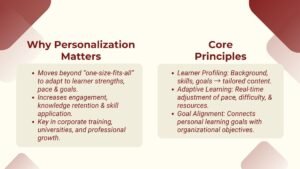
Developing custom eLearning module design for corporate departments for various departments or teams helps organizations provide content that is relevant to their learners and their specific roles, endeavors, or problems. But when they see a positive direct link between training and their day-to-day job, the engagement increases, the retention has improved and the measurable results in performance. Customization also speaks to a company’s commitment to both ongoing learning and professional development as it sends a signal to your employees that their growth is meaningful to the company.
In this article, we’ll cover how to create effective customized eLearning modules for various teams; and the primary elements that should be considered throughout the design process, and how the power of technology and data can be used to personalize the training process on scale.
Understanding the Need for Team-Specific eLearning
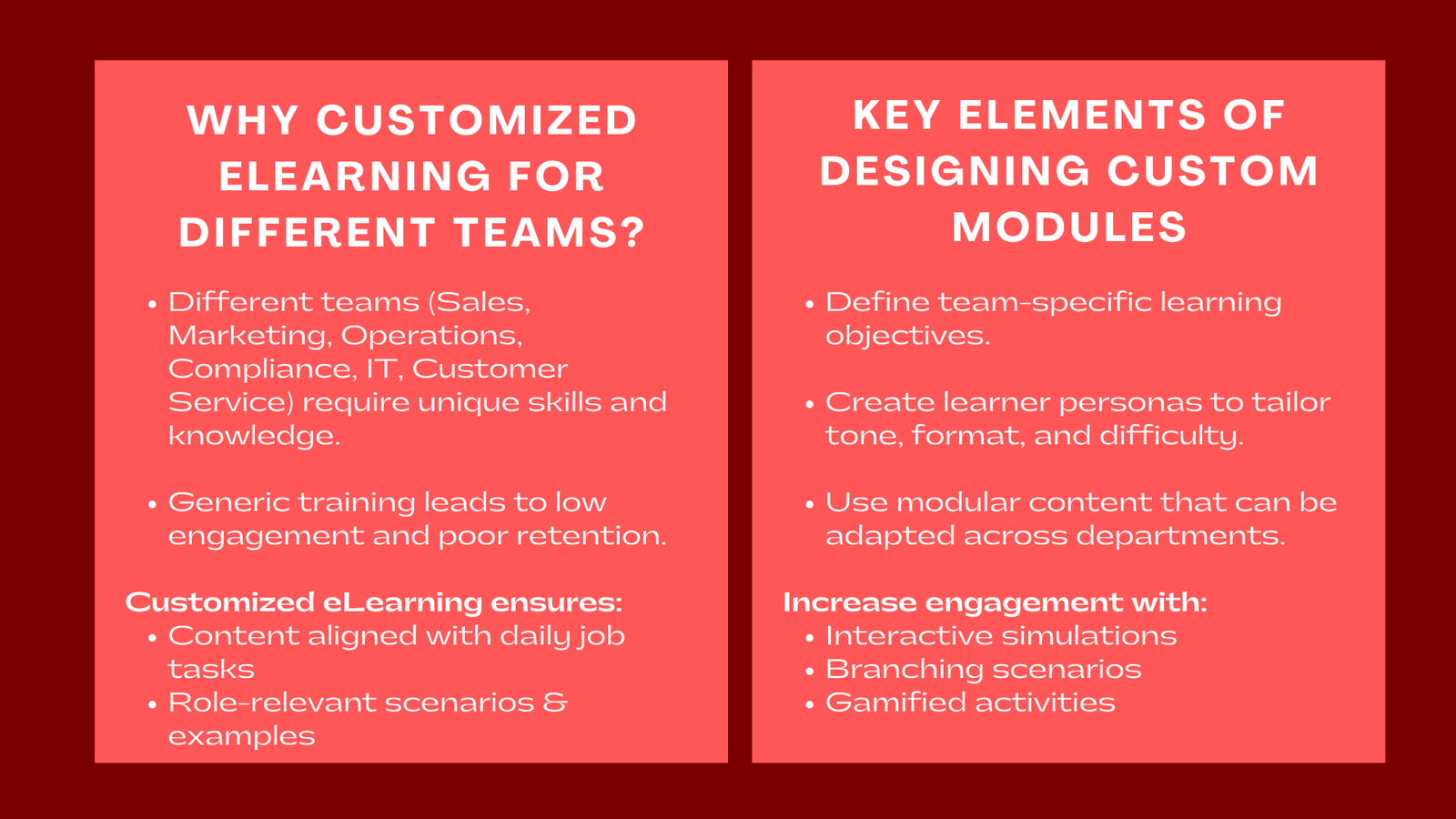
Every department in an organization has a varied contribution towards the success of a business. The marketing team might be interested in creativity and customer engagement, the finance department in accuracy, compliance and data integrity. A frontline sales team requires quick decision making and product knowledge and technical agility problems in an IT team. These differences mean that training has to take into account not only what employees do, but how they do it.
Generic role-based eLearning content development for employee training often results in disengagement due to claims of lack of relative closure. Learners with their diverse thinking are quick to lose interest when examples or scenarios or case studies do not fit the realities of their everyday life. In contrast, these team specific eLearning modules contextualize the learning process by including examples from the industry or where the role is situated. For example, compliance training on a legal department may incorporate decision based simulations based on real regulatory cases while a customer service team may benefit from interactive scenario training based on customer conversations and problem resolution.
To gain the understanding regarding needs for learning of each team requires thorough needs assessment. This is done by involving department heads, team leaders and employees themselves to identify areas of performance shortfalls, recurring issues and skill development needs. Surveys, interviews and performance data can all be useful to identify where customized eLearning can make the greatest impact. Once these kinds of insights are collected the process of instructional design is objected to align learning objectives with real life.
Designing Customized eLearning Modules for Different Teams
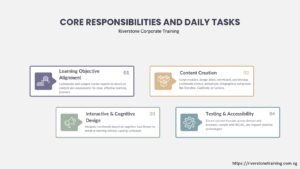
The design process starts for a customized eLearning module after defining a learning objective specific to each team. These aims form a basis for all the elements of course development – from structure and tone, to media choice and methods of evaluation. For instance, a leadership training module for middle managers will be focused on communication, delegation, and motivation of the team; and a technical support module will focus on troubleshooting, mastery of the product and customer sympathy.
One of the major aspects of the design process is to develop learner personas. These are detailed profiles that represent the target learners with; their role, experience level, learning preferences and potential challenges. By creating personas, instructional designers can better appeal to the real audience in terms of content flow and content tone. This helps to personalize, contextualize, and engage every learner with each click the very first time they encounter the eLearning experience.
With the objectives and the personas defined, the next phase would be content structuring. For team-based learning, modular design would be the best way to proceed. Modular eLearning divides up the training into smaller pre-segregated units, which are then re-combined and/or modified for use by different teams. This enables content creators to reuse certain initial materials – such as company values or compliance basics for example – but would customise examples, scenarios, and applications for each department. Solution can also be implemented, efficient and scalable.
Another world-class element of effective customized eLearning is interactivity. Rather than relying on static presentations, organisations can use simulations, role play exercises, branching scenarios, and gamified challenges that follow the tasks of team members. For instance, a team in logistics might work through a virtual supply chain to optimise delivery gardens, and a team in finance might crunch digital situations to increase the accuracy of an audit. These immersive approximates are more than making learning easier; it’s giving learning a more graphical rather than linear experience that will ensure memorization and motivation.
Visual design also greatly plays its role. The color palette, imagery, and the layout of the interface should represent the culture and work flow of the department. A sales module may prefer bold visuals and fast-paced storytelling, whereas a compliance or risk management module may appreciate clean design and rapid and efficient navigation, as well as typography. Being true to the visual tone is an indirect way of increasing engagement and emotional identification of the team.
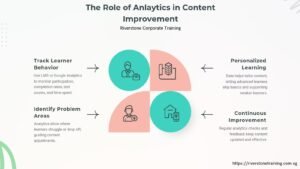
Finally, feedback and assessments should be incorporated into all the steps of learning. Quizzes, reflection points, and scenario-based assessments enable learners to quantify their knowledge as well as leaders to have insights for progress. Modern Learning Management Systems (LMS) make it possible to track completion rates, quiz results and behavioral patterns-not reverse course if they find future refineries to a module.
Leveraging Technology for Personalized Learning at Scale
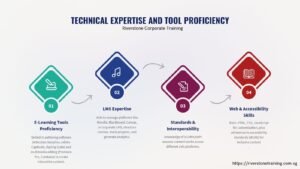
One of the amongst the most thrilling trends in modern-day corporate learning is the potential to extend personalization through the use of technology, tasked with scalability. Learning Management Systems (LMS) and Learning Experience Platforms (LXP) employ data analytics, machine learning recommendations and adaptive learning flows to execute efficient qualities of eLearning components for large organizations.
Recommendation-based systems can automatically suggest content based on jobs, competencies, and performance of the learners. For example, if a member of the marketing team is highly creative and struggles in data analytics, the system can provide them with advanced analytics tutorials or simulation exercises. Moreover, such AI-based engines can tailor course difficulty to the actual, empirical performance of the user, providing extra support in areas where it is required and moving on more rapidly where mastery is obvious.
And drawn in by that approach, microlearning has become an integral element of the customized eLearning. By making insight delivery smaller and on topic, like five minute videos, scenario simulations, etc it is easier for organizations to encourage teams to engage in ongoing learning without their day-to-day work getting in the way. This is especially useful for time-stretched departments like sales or customer service, where time and attention are in short supply.
Collaborative learning elements increase the customization in teams. Discussion boards, online workshops and peer learning tools offer the network of learners a collaborative format for experiences, case studies and knowledge co-creation. This not only creates a deeper understanding but also reinforces teamwork as well as cross-departmental communication.
At the management level, technology facilitates measuring the impact of learning down to the exact. Analytics dashboards provide valuable insights into the best performing modules, course drop off points and skills improvement after learning. These insights can be utilized to keep on optimizing the progression of content, while additionally helping to align learning strategies with the general objectives of the organization.
The Business Impact of Customized eLearning
Custom eLearning mainly builds knowledge for individual teams but goes much further-by redefining the corporate culture to positively influence business results. When employees are learning things that are tailored to them and that will help them in their jobs, they feel more confident, capable and engaged. This leads to immediate savings in terms of productivity and less turnover, because employees feel like they have a place to grow in their career.
Personalized learning also helps in maintaining uniformity of quality and standards across the departments. Even though the content of training porosity within each team may be different, it is all aligned within the organization’s general mission and values. This combination of individuality and togetherness creates a strong and united culture, which is further enhanced through custom eLearning content development Singapore for corporate training designed to meet both team-specific needs and overall business objectives.
In highly regulated industries such as finance, healthcare, or manufacturing, eLearning is also used to improve compliance outcomes with a customized approach in the process. Training that uses risk-specific scenarios also helps employees to recognize how regulation affects their job duties. This has the effect of reducing errors, boosting accountability, and curtailing legal or reputational risks.
From a strategic analysis point of view, modified eLearning leads to a long-term increase in efficiency. Instead of developing content that is generic and does not resonate with employees, multiple times over, organisations can look at developing modular frameworks that can grow and scale with employee needs. This creates a scenario of faster onboarding, ongoing skills development, and an agile work force that is always aligned with corporate goals.
Conclusion to How to Develop Customized eLearning Modules for Different Teams
The best learning programs identify the individuality of each team and employee. Overcoming barriers by creating customized eLearning modules Organizations can overcome the barriers between generic training and purpose-driven application, according to their internal needs. This learner-focused approach is not only great for engagement and retention but also communicates power in a team and gets a team capable of working with more confidence and precision.
In the era of digital change where adaptability is the order of winning, customized eLearning is no longer an option — it is absolutely essential! It signifies a process focused not on teaching but empowering, not informing but inspiring. Companies that embrace something like this create learning cultures that flourish on relevance, flexibility, and innovation – and ensure all teams contain the knowledge and skills to drive the business forward.