Gamified eLearning: Making Learning Fun and Effective
Introduction to Gamified eLearning Making Learning Fun and Effective
Gamification has fundamentally redefined how learning is designed, delivered, and experienced in modern organizations. Previously perceived primarily as a tool for entertainment or casual engagement, gamification has evolved into a central pillar of contemporary Learning and Development (L&D) strategies, particularly in corporate and professional contexts. By systematically applying game design principles such as competition, progression, feedback, and reward mechanisms, gamified eLearning platforms for corporate training Singapore transforms routine training into an immersive, engaging, and purpose-driven learning experience that motivates employees to participate actively.
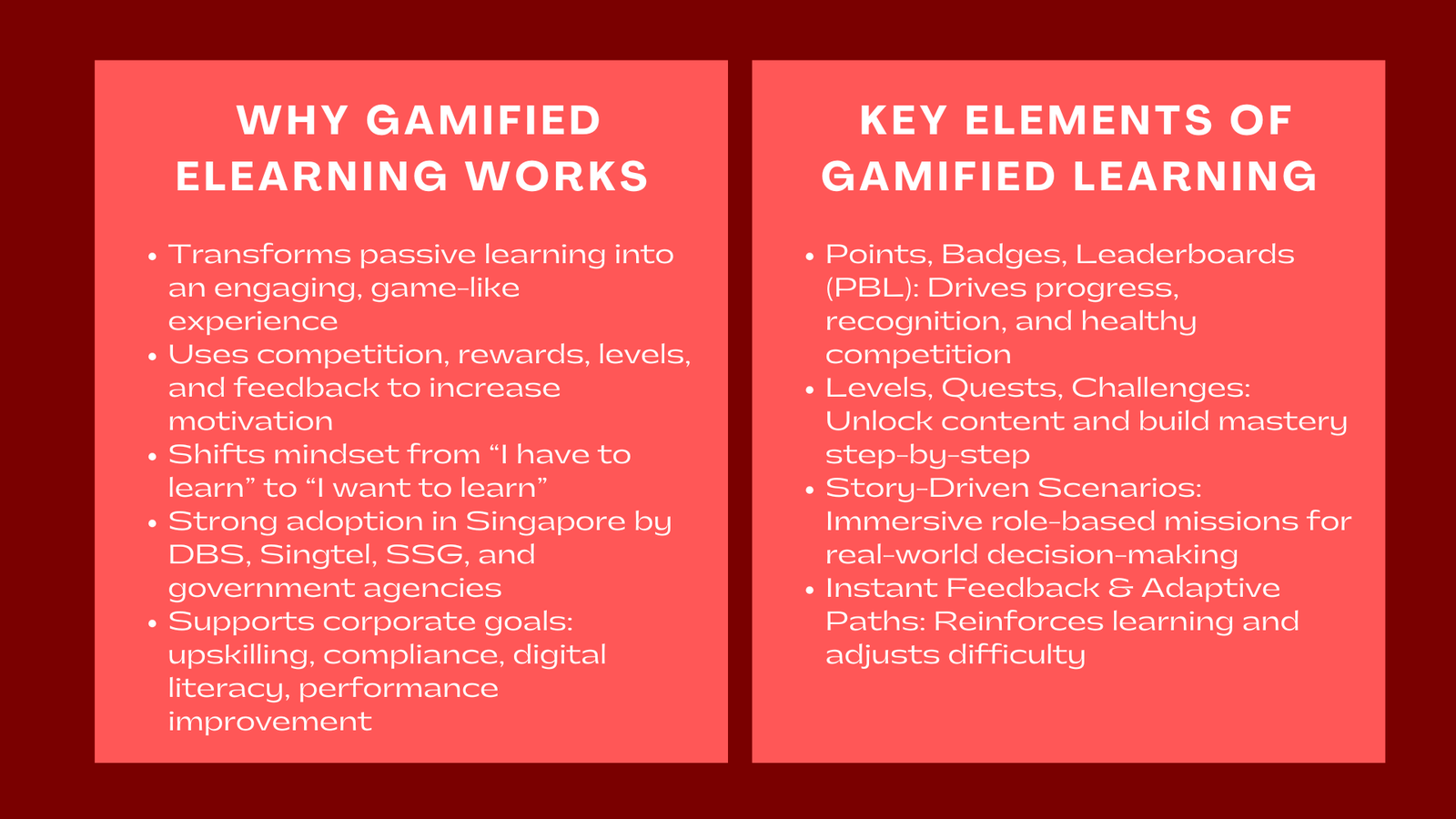
In traditional corporate education, employees often perceive compliance courses, mandatory certifications, or technical training as obligatory and monotonous. This mindset, commonly phrased as “I have to learn” rather than “I want to learn,” can hinder participation, engagement, and retention. Gamification effectively changes this perception by tapping into intrinsic human motivations for achievement, recognition, mastery, and social interaction. By doing so, learning becomes not only effective but also enjoyable, driving natural engagement that encourages employees to invest more effort and attention in their training programs.
In Singapore’s fast-paced business ecosystem, where innovation and workforce upskilling are national priorities, gamified learning has gained strong traction. Leading organizations, including DBS Bank, Singtel, and various government agencies under SkillsFuture Singapore (SSG), have integrated gamified eLearning platforms to promote self-directed learning, continuous professional development, and digital literacy. This approach not only aligns with organizational objectives but also supports Singapore’s national strategy of building a knowledge-based economy capable of thriving in an increasingly digital and competitive global market.
The Relevance of Gamified Learning
The Psychology Behind Gamification
Gamification draws heavily from the self-determination theory of motivation, which identifies three critical intrinsic motivators: autonomy, competence, and relatedness. Autonomy allows learners to make meaningful choices about how, when, and what they learn, fostering a sense of ownership over their training journey. Competence satisfies the human desire to improve and master new skills, providing tangible evidence of growth that builds confidence and reinforces effort. Relatedness emphasizes social connections, promoting a sense of belonging, community, and friendly competition within a team or organization. In this context, gamified eLearning content development Singapore supports these motivators by transforming traditional training into an engaging, goal-driven learning experience.
When these intrinsic motivators are embedded into eLearning design, learners engage more deeply, voluntarily invest additional effort, and retain knowledge for longer periods. For example, a learner completing a module in a gamified eLearning platform not only gains knowledge but also experiences a sense of progression, achievement, and connection to peers. This transforms the mindset from “I have to learn” into “I want to learn,” which is the cornerstone of successful gamification in workplace learning.
Cultural and Workplace Relevance
The relevance of gamified learning is also closely linked to contemporary workplace culture and digital habits. Employees today interact constantly with social media platforms, mobile applications, and interactive entertainment, making them highly familiar with game-like interfaces and reward systems. Gamified eLearning leverages this familiarity, creating training environments that feel intuitive, engaging, and aligned with how employees already interact with technology in their daily lives.
In Singapore, the workforce is highly diverse and multicultural, representing a range of educational backgrounds, cultural perspectives, and work experiences. Gamified learning supports inclusivity by allowing employees to progress at their own pace while sharing achievements and milestones in collaborative environments. Organizations across sectors including finance, retail, education, logistics, and technology have widely adopted gamified eLearning programs, recognizing that engagement and measurable performance improvement are critical to operational success. By reflecting the cultural and behavioral expectations of employees, gamified learning ensures accessibility and relevance for everyone in the organization.
Core Components of Gamified eLearning
Points, Badges, and Leaderboards (PBL)
One of the most common and effective structures in gamified learning is the Points, Badges, and Leaderboards (PBL) system. Points provide immediate reinforcement for micro-achievements and allow learners to track progress in real time. Badges act as symbols of accomplishment, offering recognition and social validation for learners’ efforts. Leaderboards introduce a competitive element, motivating consistent participation and fostering healthy competition among employees.
Example: A telecommunications company in Singapore implemented a PBL-based customer service training program. Within three months, course completion rates exceeded 95%, and post-training satisfaction improved by 30%. Employees reported feeling more motivated to complete modules, while managers observed higher levels of engagement and improved customer handling outcomes.
Levels, Challenges, and Quests
Dividing training into levels, challenges, and quests creates a structured sense of progression that keeps learners motivated. Each stage represents mastery over a skill or concept, encouraging learners to move forward out of curiosity and a desire to achieve. For instance, a cybersecurity training program might allow learners to progress from “Rookie Analyst” to “Threat Hunter” and ultimately “Cyber Guardian,” unlocking new content, challenges, or rewards at each stage. This layered progression mimics the mechanics of role-playing games, keeping learners committed and engaged throughout the training journey.
Storyline-Based Gamification
Storyline-based gamification leverages narratives as emotional anchors, placing learners in realistic, scenario-based environments. Employees may act as detectives solving fraud cases, managers handling crisis situations, or engineers repairing virtual systems. The narrative creates immersion, making learning experiences memorable and meaningful.
Example: A Singaporean bank launched an anti-fraud module titled “Operation SafeCode,” where employees assumed the role of digital investigators. The storyline-driven module increased engagement, fostered critical thinking, and led to a 40% improvement in fraud detection accuracy during internal audits. Story-based gamification ensures that learners not only acquire knowledge but also apply it in simulated real-world scenarios.
Instant Feedback and Adaptive Progression
Immediate feedback is a critical feature of gamified eLearning. Learners can instantly see their performance, corrections, and rewards, which reinforces memory retention and motivation. Adaptive gamification systems further enhance learning by adjusting challenge levels dynamically based on individual performance, ensuring continuous engagement regardless of prior skill level.
Case: A Singapore healthcare training platform incorporated adaptive feedback loops in its clinical skills module. Learners who answered incorrectly received instant explanations and had multiple opportunities to reattempt tasks, resulting in an 18% boost in test accuracy. Adaptive feedback ensures that learners remain challenged while avoiding frustration or disengagement.
Collaborative and Competitive Modes
Social interaction is a key driver in gamified learning. Leaderboards, group missions, and peer recognition introduce elements of collaboration and competition, fostering a sense of community, accountability, and motivation to excel. Employees are more likely to remain engaged when their efforts are visible and recognized by peers, creating a culture of learning that is both fun and effective.
Implementation Strategies for Gamified eLearning
Define Clear Learning Objectives
Gamification should always serve the learning objectives rather than overshadow them. Before implementing game elements, organizations must define specific behavioral and performance goals, such as improving compliance accuracy, enhancing product knowledge, or increasing customer interaction quality. Clear objectives guide the choice of game mechanics and ensure the program remains purposeful and outcome-driven.
Choose the Right Gamification Mechanics
Different mechanics serve different purposes. Quests and challenges are effective for exploration-based learning, badges and levels maintain engagement over longer-term programs, and leaderboards suit competitive, fast-paced environments. Misalignment between objectives and mechanics can reduce engagement, increase cognitive load, and compromise learning effectiveness.
Align with Organizational Culture
Gamification must reflect organizational values and workplace culture. In highly collaborative organizations, team-based achievements may be prioritized, whereas performance-driven workplaces benefit from individual tracking and public recognition. In Singapore, where efficiency, achievement, and respect are highly valued, balanced gamification that rewards both collaboration and individual effort often yields optimal results.
Integrate into LMS and HR Systems
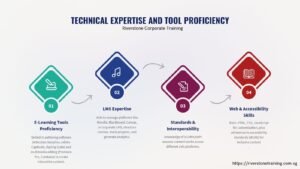
Modern Learning Management Systems (LMS), such as Docebo, TalentLMS, and SAP SuccessFactors, offer built-in gamification features. Integrating gamified eLearning with HR analytics enables performance tracking, links achievements to career progression, and embeds learning within broader organizational development strategies.
Data-Driven Monitoring
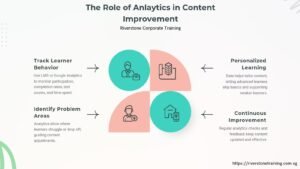
Gamified learning generates large volumes of engagement data, including points earned, badges achieved, and average completion time. Analyzing this data helps L&D managers identify high performers, disengaged learners, and content effectiveness.
Example: A Singapore manufacturing company used gamified analytics to identify employees struggling with safety training. Targeted coaching interventions resulted in a 25% reduction in workplace safety incidents, demonstrating the direct operational impact of gamified learning.
Strategic and Analytical Thinking in Gamified Learning
Decision-Based Game Scenarios
Decision-based gamification simulates real-world complexity, helping employees develop strategic judgment. For example, financial analysts might participate in virtual investment simulations where every decision affects the final portfolio outcome. These exercises enhance analytical skills, risk management, and critical thinking under pressure.
Example: A Singapore-based asset management firm implemented a “Virtual Trading Challenge” for analysts, which improved accuracy and decision-making in real investment scenarios.
Critical Thinking through Problem-Solving Missions
Gamified problem-solving missions encourage logic, creativity, and teamwork. Employees develop analytical skills while collaborating on challenges that mimic real-world work situations, fostering adaptability and resourcefulness—key traits in leadership development programs.
Behavioral Conditioning
By associating positive reinforcement with desirable actions, gamification encourages consistent behavior. Compliance and ethics training, for instance, can reward employees for making correct ethical decisions in simulated dilemmas, reinforcing corporate integrity culture and embedding core organizational values.
Technology Integration and Automation
Artificial Intelligence (AI) and Personalization
AI enhances gamification by personalizing challenges, rewards, and recommendations. Systems analyze learner behavior and performance, adapting content complexity dynamically to maintain optimal engagement.
Example: A Singapore logistics firm implemented an AI-driven gamified compliance platform that adjusted quiz difficulty based on previous attempts. Engagement increased by 52%, and repeat violations declined by 37%, demonstrating AI’s effectiveness in improving learning outcomes.
Augmented Reality (AR) and Virtual Reality (VR)
AR and VR provide immersive, experiential learning. Employees can practice skills in simulated environments, enhancing retention and confidence while reducing risk.
Case Study: At a Changi aviation training center, VR flight maintenance simulations allowed trainees to earn digital “flight wings” upon module completion, boosting both engagement and certification pass rates.
Mobile and Cloud Integration
Mobile-enabled gamified learning allows employees to access training anytime, anywhere. Mobile dashboards track progress, display leaderboards, and provide motivational notifications. Cloud infrastructure ensures centralized data storage and scalability for multinational companies operating across regions.
Analytics and Dashboards
Real-time dashboards visualize learner progress, highlight skill gaps, and correlate training achievements with job performance. This enables data-driven decisions in talent management and informs future L&D strategies.
Advantages of Gamified eLearning
Gamified eLearning enhances engagement, making training enjoyable rather than mandatory. Immediate feedback and repetition improve knowledge retention, while intrinsic motivation encourages learners to pursue mastery for personal satisfaction. Organizations observe measurable improvements in performance metrics, interactive gamification strategies for employee learning Singapore, including higher test scores, better compliance, and improved behavior. Gamification fosters collaboration, strengthens organizational culture, provides data-driven insights, and can be tailored to diverse teams or industries. It also promotes continuous participation and lifelong learning, creating a sustainable learning ecosystem.
Conclusion
Gamified eLearning is where education, psychology, and technology intersect. It transforms mandatory training into immersive, achievement-oriented experiences, turning learning from obligation into personal and professional growth. In Singapore’s forward-looking workforce culture, gamification aligns with national priorities of lifelong learning, workforce upskilling, and digital transformation. When implemented strategically and monitored analytically, gamified eLearning not only makes learning enjoyable but also effective, measurable, and sustainable. Organizations that invest in gamified systems cultivate knowledge, engagement, loyalty, and innovation — one challenge, one badge, and one achievement at a time.