Future of eLearning Content Development: Trends and Innovations
Introduction
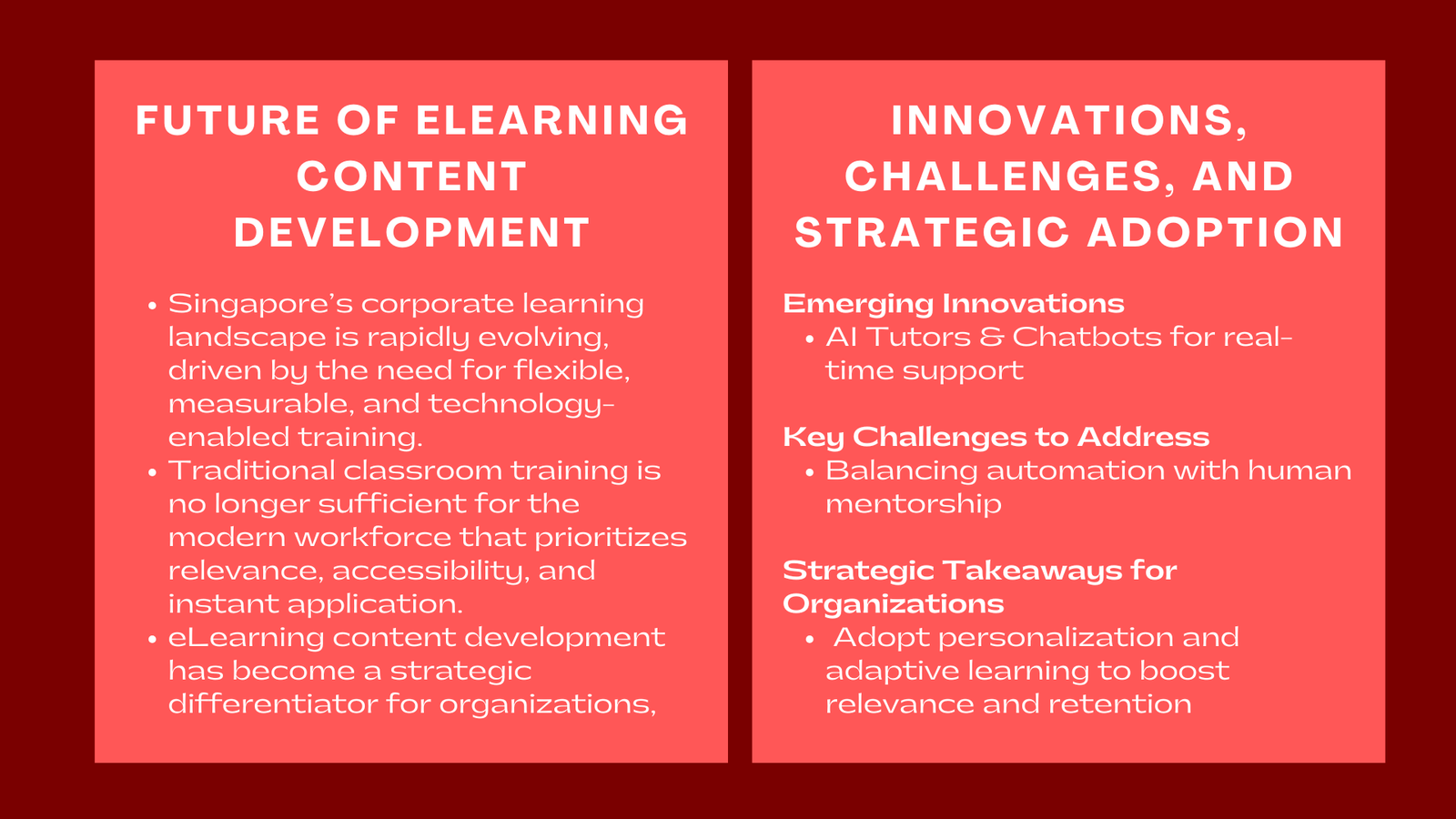
The corporate training and education environment in Singapore is changing at a rate that has never been experienced in the history of Singapore. Organizational leaders are under pressure to provide active, effective, and measurable learning to the workforce to help organizations enhance skills and do so more efficiently using emerging technologies. The conventional paradigm of training at the classroom level is now inadequate to support the dynamic nature of the current workforce particularly with the employees putting more emphasis on flexibility, relevance and immediacy in their learning activities. With the new trend of businesses abandoning traditional ways, one of the most essential success determiners in an organization has come to be through eLearning content development.
Future of eLearning content development in Singapore is determined by emerging technologies, emerging workforce needs and emerging learning methodologies. Business organizations are now challenged to incorporate interactive, personal and data based training programs, which do not only impart skills training but also deliver quantifiable business results. As a way of surviving in this climate, organizations would need to be aware of these trends and provide them with strategic positioning in the training programs. Professional eLearning content development services offer expertise, tools and structures that are requisite to develop learning solutions that are future-ready and adapted to the diverse and highly skilled workforce of Singapore. They merge the instructional design principles, integrating technology, and psychology of the learner in order to make the training effective and interesting. This paper will investigate the major trends, innovations, and best practices that will characterize the coming generation of eLearning content development as these applications will help organizations to create meaningful, user-friendly, and technology-based training programs that support strategic objectives.
 Personalized and Adaptive Learning
AI-Powered Personalization
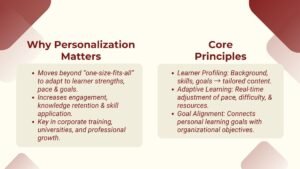
Elearning is transforming with the use of Artificial Intelligence (AI) that shapes personalized paths of learning to employees. Routine one-size-fits-all training is not very exceptional to cover individual deficiencies in skills or learning styles and thus results in a lack of engagement and engagement and ineffective results. The contemporary AI-powered adaptive learning platforms Singapore monitor the behavior of the learners, their metrics of performance, and patterns of interaction and provide dynamic changes in the content so that employees can concentrate on the areas where they can improve whilst neglecting the ones they have already mastered.
An instance is a finance department worker who is receiving training on regulatory compliance, he/she might get module training see new amendments in the Monetary Authority of Singapore (MAS) guidelines without being subjected to basic principles of which he/she is well versed. This degree of personalization does not only save time but also keeps the learners at the edge of their seats by bringing onto them relevance which is instant. The motivation can be extended by the individual learning paths too, because employees will feel that the training is identifying their personal needs and progress, and the learning process will be meaningful and more efficient.
Dynamic Content Recommendations
In addition to adaptive pathways, AI may also propose additional learning materials such as articles, videos or case studies or interactive activities, depending on the progress and performance trends of the learners. An example would be that in case an employee is having trouble with a situation in a risk management simulation the system can suggest specific practice activities or other reference material to the employee automatically. Gradually, adaptive learning provides a very personalized experience, which can match the growth of skills of a person, and a learner is only supported at the point when it is needed. This is what will turn eLearning into a game of hot and cold instead of a lifeless training program.
Immersive Learning Technologies
Virtual Reality (VR) in Corporate Training
Virtual Reality (VR) enables students to be able to interact with realistic and immersive situations in a controlled and safe environment. This is especially useful in the case of the industries which include healthcare, manufacturing, aviation and logistics as any error in real life can have serious consequences. VR simulations provide learners with the opportunity to work with more complicated tasks, learn the process of work, and go through critical situations.
To provide an example, VR may also imitate troubleshooting of the machinery in a manufacturing facility or recreate emergency response failures as a safety training to let the employees experiment and learn without making mistakes in a safe way. Through experiential learning, VR improves memory retention, critical thinking and confidence to perform tasks.
Augmented Reality (AR) for On-the-Job Learning
In Augmented Reality (AR), the digital information is presented over the real-life setting and enables the learners to engage the systems or apparatus in real-time. In a technician example, when a technician is being trained to repair a machine he or she might watch step-by-step instructions and others using AR, which would involve a blend of experience and learning. AR helps in eliminating mistakes, fastens the learning process, and improves employee confidence because they receive contextual help when the need arises. Visual notifications or checklists can also be displayed on AR within such industries as logistics or healthcare, increasing the efficiency and compliance of a particular process.
3D Simulations and Scenario-Based Learning
3D simulation offers the continuation of immersive learning in the form of interactive environments with the employees required to make decisions, consider the outcome, and investigate performance. The exercises are most effective in positions that involve problem solving, leadership, as well as other intricate knowledge of operations. An example is that in a management simulation, the participants may be asked to distribute resources, deal with risks, and act unexpectedly. Learning in a risk-free online platform enables the learner to get experience, develop decision-making ability, and transfer knowledge to a real-life working situation. The engagement and retention in 3D simulation is also facilitated by its interactivity and realism factor which is not experienced under conventional means of simulation.
Mobile Learning and Microlearning
Anytime, Anywhere Learning
The flexibility exhibited by mobile learning allows the employees to access the training material through smart phones, tablets or laptops, unparalleled. It is more useful, especially to the organization that has a remote workforce, regularly traveling employees or balancing work and other tasks. Mobile friendly modules enable the learner to incorporate education into the real-life activities, be it when commuting to work, or during a break or in between appointments. Organizations can expand the participation rates, enhance the completion, and create the culture of learning any time and anywhere by rendering learning accessible.
Microlearning for Efficient Knowledge Acquisition
Microlearning divides content into small bitable bites that can be achieved over a short period of time. This process is able to assure essential ideas and processual understanding and regulatory changes better than lengthy courses. Indicatively, a five-minute module about the best practices related to cybersecurity can be used to provide narrow knowledge that will be more recalled and will be applied by the employees compared to a one-hour long conventional lecture. Just-in training also fits well in microlearning and learners can have access to the precise information that they need at the most required time.
Push Notifications and Just-in-Time Learning
Mobile platforms can also send push notifications to remind the employees of the next deadlines and reinforce learning or give the employees just-in-time guidance in the face of important tasks. As an example, a sales representative might be given a short update of the features of a product just before a meeting with a client and this may help him improve his performance and self-esteem. The relevance, contextual and actionable characteristics of training are maintained by just in Time learning so that the employee can use the knowledge immediately and efficiently in the workplace.
Gamification and Engagement Strategies
Game-Based Learning
Gamification changes the process of learning into a competitive, interactive one. Employees will be allowed to earn points, unlock levels, and compete on leaderboards to encourage one to be active in the long term. Gamification prompts the repetition of content and skills, and more effective learning through the introduction of elements of play it promotes. The game approaches are especially useful when it comes to the situation when problem-solving, strategy, or procedural mastery is needed, since the game approaches allow one to enjoy the training process but learn at the same time.
Recognition and Rewards Systems
Rewards systems, certification and digital badge systems offer recognition of the learner through visible means. The tools can be partnered with LMS systems to monitor the progress, congratulate the achievements, and motivate the continued use. The recognition systems set the feeling of completion and encourage the learners to seek additional training opportunities. They also give the employers a quantifiable account of improvements, which show the employees who have excelled in terms of learning commitment.
Simulated Challenges and Team-Based Competitions
Simulations through gamification which mimic the workplace scenarios enable the employees to grow regarding critical thinking, teamwork, and problem solving in a safe environment. Competitions which are done through teams are associated with winning games which generate friendliness and healthy competitions, and promote knowledge and peer learning. An example here would be virtual problem resolution and cross-departmental teams can be put in virtual problem scenarios where they are able to devise the most effective operation solutions and this is coupled with team building experiences.
Social and Collaborative Learning
Peer-to-Peer Knowledge Sharing
Using social learning helps to motivate employees to exchange knowledge, pose questions and share them using forums, group work, and discussion boards. The peer-to-peer interactions lead to the establishment of culture in which knowledge flows naturally and leads to the elimination of silos and encourages organizational learning. When formal training material is combined with other factors, employees get real-life experiences through other employees who have gone through their challenges in life.
Online Communities of Practice
Virtual communities of practice give employees the alternative of networking, being offered a chance to share knowledge with experts working in different departments or geographical locations. These communities promote mentorship, cross-functional teamwork or work, and lifelong learning. As an example, a project manager community can share their ideas on risk management or team leadership that can facilitate knowledge retention and development of skills.
Collaborative Projects and Feedback Loops
Cooperative projects throughout eLearning modules help learners to cooperate in problem solving activities, get constructive feedback and hone skills in a well structured interactive environment. The feedback mechanisms enhance learning, outcome and keep the participants engaged. Through collaborating with real time feedback, learners will be self-confident, utilize their skills well and also feel that they own the development of knowledge together.
Analytics and Data-Driven Learning
Learning Analytics for Performance Insights
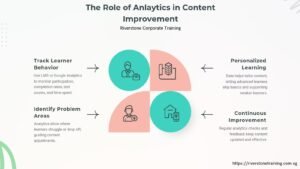
The complex LMS systems gather detailed performance information of interaction, assessment outcomes, module coverage, and knowledge storage. This data can be analyzed in the organization to determine patterns, areas that can be improved, and optimizing future content. Analytics of learning allows focusing on specific interventions that allow managers to work with shortcomings, support weak points, and congratulate high-achieving employees.
Predictive Analytics for Proactive Learning
Predictive analytics are further data-driven and are used to predict the challenges encountered by learners and project skill shortages. Predictive models can be used to offer intervention opportunities by monitoring patterns of engagement, performance in assessments and completion rates in the case of learners falling behind. With such a proactive strategy, training is needed to meet the needs as they arise and learners will get timely support to make most out of the individual or organizational performance.
Linking Learning Metrics to Business KPIs
The use of data-driven knowledge enables an organization to furnish a correlation between the eLearning outcomes and the important business performance indicators. As an illustration, the successful completion of a sales training program can be associated with an elevated number of sales converting into sales, whereas a compliance program can be associated with a lower number of regulatory breaches. Organizations can evaluate the ROI of eLearning programs as well as make strategic decisions by relating the learning information with the visible business outcomes.
Emerging Technologies and Innovations
Artificial Intelligence Tutors
Virtual tutors run by AI have the capability to respond to questions of the learner, give clarification, and show someone what to follow in real-time. Such individual attention would enhance an understanding, solidify ideas, and limit reliance on human trainers in response to the everyday questions. The employees obtain individual contributions at the right time at the point of need and increase efficiency and learning satisfaction.
Chatbots for Continuous Support
LMS chatbots based on AI assist learners 24/7, monitor their progress and send timely notifications. Chatbots will also improve the learning experience and engagement of learners, as well as decrease the administrative load a training team carries. Students are able to seek advice anytime thus allowing them to learn independently and solve their problems instantly.
Blockchain for Credentialing and Security
The blockchain technology has the benefit of providing verifiable certification, proper historicity of learning and integrity assurance of data. It establishes confidence in the professional development programs where the employer and the employee can establish credentials in a reliable manner. The systems developed using blockchain also support lifelong learning as they make verifiable records across the courses and organisations.
Voice-Enabled Learning
Voice technology enables the learners to communicate with the content by using natural language instructions. The voice enabled modules increase ease of access and help busy professionals to learn without using their hands. Voice commands allow learners to ask questions, seek information or perform interactive exercises, a facility that makes learning comfortable and contributes towards inclusivity of employees with varying learning abilities.
Challenges and Considerations
Balancing Technology and Human Interaction
Although technology increases the learning process, human interactions are needed in mentoring, coaching and developing the soft skills. Good programs combine the technical content delivered by technology and the option of instructors leading the trainee will be focused on providing both experiential and other relational learning to the employees. The supervision of human resources beats automated systems, which supports the organizational culture and values.
Accessibility and Inclusivity
The eLearning products in the future should support language diversity, cultural relevance as well as access requirements. Development of inclusive contents will guarantee equal participation and help employees with physical disabilities. All these factors, captioning, screen-reader compatibility and visuals of high contrast, contribute to establishing learning environments that allow all employees to succeed, and corporate social responsibility and diversity objectives are supported.
Continuous Content Updates
The industries and regulations are changing at a great pace and it is important that the eLearning content is up to date, reliable, and in line with the organizational goals. Periodic updates will keep up with the time, increase credibility, and make sure that employees learn what they can use during the course of their duties. Constant content review also enables the organizations to accommodate the new trends, technologies and learning conformity.
Conclusion to Future of eLearning Content Development: Trends and Innovations
Personalization, immersive technologies, mobile microlearning, gamification, social learning, analytics, and AI-led innovations are defining the future of eLearning content development in Singapore. By having strategic approaches to the adoption of such trends, organizations can make interesting, measurable, and future-proof learning experiences that will produce performance in the workforce and organization success, especially as eLearning content development and trends Singapore continue to evolve in response to digital transformation demands.
The skills that come with professional learning development services are to create programs that are learner focused, integrate innovative technologies and implement sound measurement systems which will make sure that training in practice turns to practice. The firms that adopt such innovations will not just have developed employee skills but also promote the culture of constant learning, being versatile, and innovativeness. With the ever growing competition in the corporate world, those organizations with access to the next generation of eLearning technologies will be in a better position to attract, retain, and develop the best and record sustainable growth and strategic goals in the long term.