Best Practices for Creating Engaging and Effective eLearning Content
Introduction
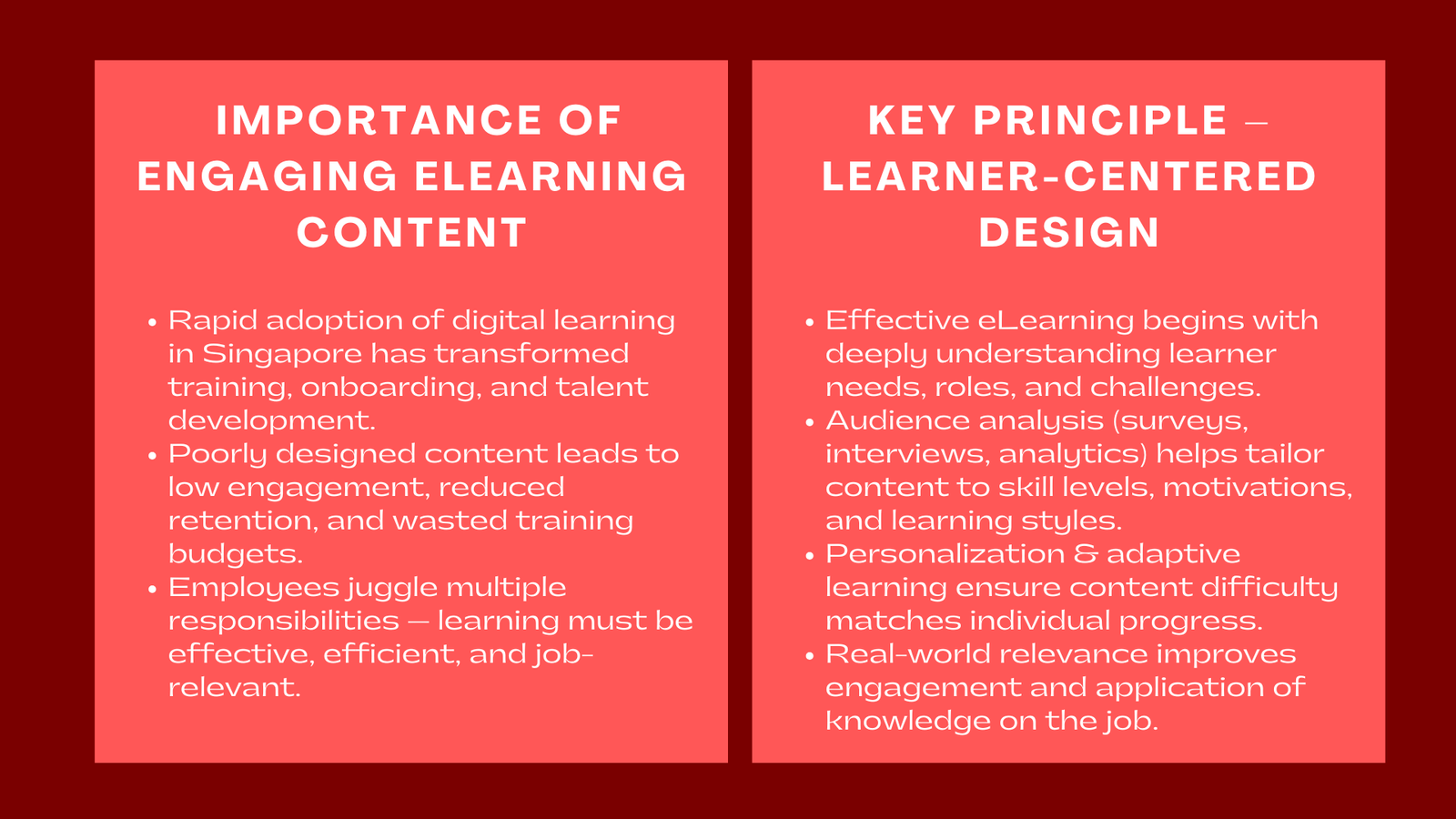
Digital learning has been adopted at a rapid rate in Singapore and this has changed the way organizations train, onboard workers, as well as developing talents. Although eLearning offers flexibility and scalability, desired results are not always the case with online courses. The lack of proper content may result in loss of attention, reduced retention and training budget wastages. Besides, employees have several responsibilities in a hectic corporate world, thus it is important that learning processes become effective and efficient. When content does not attract and bring relevance to the job roles, learners can drop modules and this leads to missed out chances of acquiring vital skills.
Organizations should pay attention to good practices in eLearning content development services in order to make digital learning maximally effective. A good learning content will capture the interest of the learners, strengthen knowledge and encourage performance changes. It also takes care of equipping the employees with the appropriate skill to survive the shifting business environments, regulatory needs and technological changes. The article is a comprehensive guide on best practices for engaging eLearning content development Singapore, effective, and aligned with the organizational learning goals, provides the practical strategies, real-world examples of the various content development strategies and provides the insights of professional content development practices.
Learner-Centered Design
Understanding Learner Needs
It starts with the preparation of entertaining eLearning content through the knowledge of the audience. Different stages and ages of acquiring knowledge need different approaches with learning and with the corporate workers the scenario-based way with the technical employees might be offered the necessary simulation. Professionals also vary in terms of knowledge level, technological skills, and level of motivation that largely determine the way they interact with material on the internet. Professional eLearning services tend to perform thorough analysis of the audience by use of surveys, focus groups, interviews and data analytics. The information obtained, through such analyses, is useful in customizing the content, learning styles, and varieties of interaction. As an example, a diverse workforce can require information using a variety of languages or formats in order to support varying levels of literacy as well as familiarity with technology. Knowledge of effective learner-centered eLearning content strategies including tasks they do on a daily basis, their challenges, and objectives enables the instructional designers to come up with content that is instantly relevant, practical and applicable and enhances engagement and coping of knowledge.
Personalization and Adaptive Learning
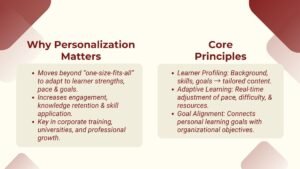
Individually customized learning ensures that every learner is relevant to the contents. Adaptive learning also uses smart algorithms to increase or decrease the level of difficulty and content based on the performance of the learners to ensure that neither the challenges are too easy nor too challenging. This technique increases the level of interaction, minimizes frustration and or increases the level of knowledge retention. Individualised learning programs also target areas that learners require improvements on and thus they will not waste time on information that they are well aware of. An adaptive module in an example like cybersecurity training can be used to make learning more challenging to the learners when they are doing well and may add more resources to the learners that are facing problems in a particular concept. Likewise, the scenario-based exercises can be customized to a specific role or past experience of a learner and create a unique learning process with a leader in order to achieve the maximum. Special dashboards and progression also encourage the learners because the success would be displayed using visualized charts, and the improvement would be emphasized in real time.
Engaging Content Strategies
Storytelling and Scenarios
Learning based on narratives and scenarios gets the learners closer to the world. Storytelling makes the learning process more emotionally charged and enables learners to correlate the theoretical and practical part thereof. Learners tend to memorise better when they can visualise the immediate implication of the application of the knowledge thus being able to transpose it into everyday work. An example of this is that the employees in a finance compliance course may be put in a situation that requires them to recognize red flags in a simulated audit, and this encourages them to actively apply the knowledge they have studied as opposed to reading about it passively. Likewise, training programs in healthcare can emulate interactions with the patients and call upon the learners to make choices that influence the results. This is because in addition to influencing the ability to think critically and solve problems such immersive experiences also create sustained engagement between the learner and the course.
Multimedia Integration
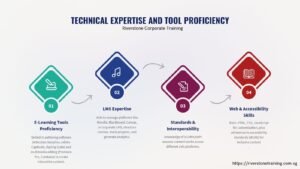
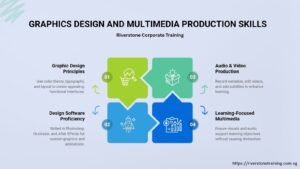
Successful eLearning material combines using several forms of media to suit the various learning styles. Video demonstrations aid learners as they get an idea of processes, workflow, and complex concepts, abstract concepts become easier to learn with the aid of visuospatial information. The use of infographics simplifies the information in order to understand it quickly and presenting visual clues that can improve new information remembrance. Through animations, abstract ideas like organization structures, market patterns or even series of data can be given a non-technical view that is easier to digest, which is why eLearning content development Singapore providers often integrate multimedia elements to maximize learner engagement. Audio narration is used to supplement the text information, supporting the information given to the auditory learners to reinforce information and enhance effectiveness to the listeners who do not prefer reading information as much as listening. Branching scenarios and elements that allow interaction are interactive and useful such as clickable graphics, drag-and-drop exercises, and simulations. As an illustration, a manufacturing safety module can be confined to simulating an emergency situation when the learners have to choose proper action, immediate feedback, and the learners are to know the outcomes of their decision but without any risks in the real world. This kind of interaction will make sure that learners learn more about knowledge and are assured that they can apply their knowledge comfortably in the field.
Gamification
Game-like features (points, badges, leaderboards, challenges, and others) can contribute greatly to motivation and engagement. Gamification offers instant feedback, allows one to practice over and over again, as well as develops a feeling of achievement. A sales training module may be used as an example; in that case, the module will be simulating the interactions with clients where learners will gain points or badges as a sign of successful strategies. Leaderboards make a workplace environment useful in terms of healthy competition among the colleagues, which makes them more motivated and responsible. Even long or complicated coursework can be made more interactive as the gamified course means that a student can view the development of progress and celebrate success visually. The behavioral reinforcement, which is obtained with the help of gamification, may result in better performance and mastering skills in the actual workplace situation over time.
Instructional Design and Learning Science
Apply Learning Theories
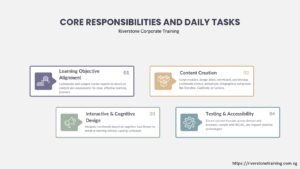
The most successful eLearning content is based on scientifically valid learning theories to ensure that learning content is internalized by the learners. Cognitive Load Theory, for example, suggests that information overload should be avoided by presenting material in manageable chunks and Bloom’s Taxonomy offers a framework in which to move from learning knowledge, to application, analysis and evaluation. Constructivist theories involve learners engaged in the process of creating meaning through problem-solving, trial and error and reflection. Instructional designers use these theories to pave the way for deep learning and long-term retention. Thus, for example, a course in project management may start with knowledge, proceed to application in cognitively demanding case studies, and end in a high-fidelity simulation where the learner makes decisions and then returns to reflect upon the consequences of their decisions. This approach not only stimulates understanding and comprehension, it encourages thinking critically and developing skills and experience.
Chunking and Microlearning
Microlearning, also known as breaking content into smaller, targeted modules, makes it easier for the learners to take in information. This is why micro-training removes cognitive load, keeps employees engaged, and makes it effortless to achieve a finished training in small bites. For example, one hour of compliance training can be broken down into six lessons each taking ten minutes to broadcast with a particular regulation. Students are able to learn at their own pace, repeat sections of content that they need to, and piece together the knowledge along the way. Microlearning is also a good fit for mobile learning where employees can access the modules anytime, be it during a commute or a quick break. This flexibility is found to improve course completion rates and support just-in-time learning which is especially valuable in fast moving work environments.
Assessment and Feedback
Formative Assessments
Frequent quizzes, interactive exercises, and scenario-based questions offer continuous feedback so that learners can see where they are lacking knowledge and reinforce this knowledge as soon as it is discovered. Formative assessments help to prevent problem misconceptions from being ingrained, by providing corrective feedback in real-time. For instance, a product knowledge module may contain interactive quizzes post-section where learners can self-test to learn and review right away what areas need help. This constant reinforcement not only helps the learners to retain information but in building up their confidence of applying the information learned.
Summative Assessments
Summative assessments are used to assess knowledge and skills at the end of a course. The impacts go beyond outcomes in terms of learning, but also feed into decision-making around course effectiveness, further training requirements and managerial interventions. However, eLearning platforms can offer in-depth analytics that help organizations understand smaller trends in performance and, as a result, enable them to improve their content, hit back on learners who need support, and streamline learning for future programs.
Feedback Loops
Learners should be provided opportunities to give feedback relating to content, usability and engagement. Surveys, polls and discussion forums open the way for learners to provide their points of view, which helps to inform iterative updates and ensure that content is relevant, effective and fit for learners’ expectations. Engaging employees in feedback processes also helps to build a sense of ownership in which learners perceive that what they are providing is of value in the design and improvement of the learning experience.
Accessibility and Inclusivity
Designing for All Learners
Inclusive design: Content must be inclusive to ensure that learners who have disabilities are able to get access to everything and gain the full benefits from it. Videos should be captioned for hearing impaired learners, text should be screen reader compatible for visually impaired learners and high-contrast colors should be used for clarity. Modules also have to be navigable by keyboard, to cater for individuals who may not be able to use a mouse. Designing with accessibility in mind not only means complying with regulations but also ensuring equality of learning opportunities that helps ensure engagement of all employee demonstrations.
Cultural Sensitivity
Content should not be biased, nor expect varying cultural backgrounds. Inclusive content helps increase engagement, prevents the risk of misunderstanding, and is connected to organizational policies for diversity and inclusion. Case studies, examples and imagery should reflect a range of cultures, but not stereotypes. Training that embraces cultural sensitivity can help to combat collaboration between multinational teams, and ensure that all learners feel represented, valued and respected throughout the learning process.
Continuous Improvement and Best Practices
Data-Driven Iterations
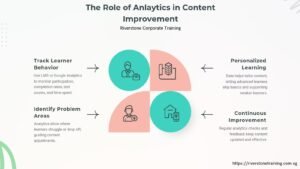
The ability to track learner engagement, completion rate, and assessment performance is a valuable source of information to improve content. Analytics can show what are effective modules, which modules need improvement, and which instructional strategies result in the most knowledge retention. It is tracked in advanced eLearning platforms what users are doing, how much time they spend on lessons, and which patterns of interaction they have, which enables instructional designers to make knowledgeable changes that increase learning outcomes.
Staying Current
Content must be regularly updated to reflect the latest industry practices, new regulations and changes in technologies Team up with professional eLearning content development businesses which makes organizations applicable for the duration. For instance, compliance training programs in Singapore must include recent changes in regulation, while technical training programs must integrate changes in software tools or use. This will ensure that the content does not become outdated and that the employees are developing the skills that will remain relevant in a dynamic work environment.
Collaborative Development
Subject-matter experts, instructional designers, and technology experts teaming up result in richer, more accurate, and interesting content. Through the collaboration process, courses are aligned with organizational goals and multiple perspectives are incorporated into the courses. For example, it is critical for human resources teams to be able to provide insights on soft skills development, while technical teams can make sure simulations are representative of reality. This approach of working together helps provide a comprehensive learning experience that combines theoretical knowledge with practical knowledge and helps to improve the overall quality of the contents.
Conclusion to Best Practices for Creating Engaging and Effective eLearning Content
You need a well-planned and thoughtfully designed eLearning course to create learner-centred eLearning, integrate multimedia, gamification, integrate assessment strategies, make sure accessibility, and continuously develop. By following these best practices, organizations in Singapore can maximise the learning results and enhance the performance of their employees to ensure long-term success. As is the case with well-designed eLearning content, this leads to a culture of constant learning where employees are motivated to upskill, adapt to change and contribute meaningfully to organisational goals. Working with expert eLearning content development services will guarantee superior quality, measurable and future-proof digital learning solutions that are in line with learner requirements and business goals.