Step-by-Step Guide to eLearning Content Development
Introduction to Step-by-Step Guide to eLearning Content Development
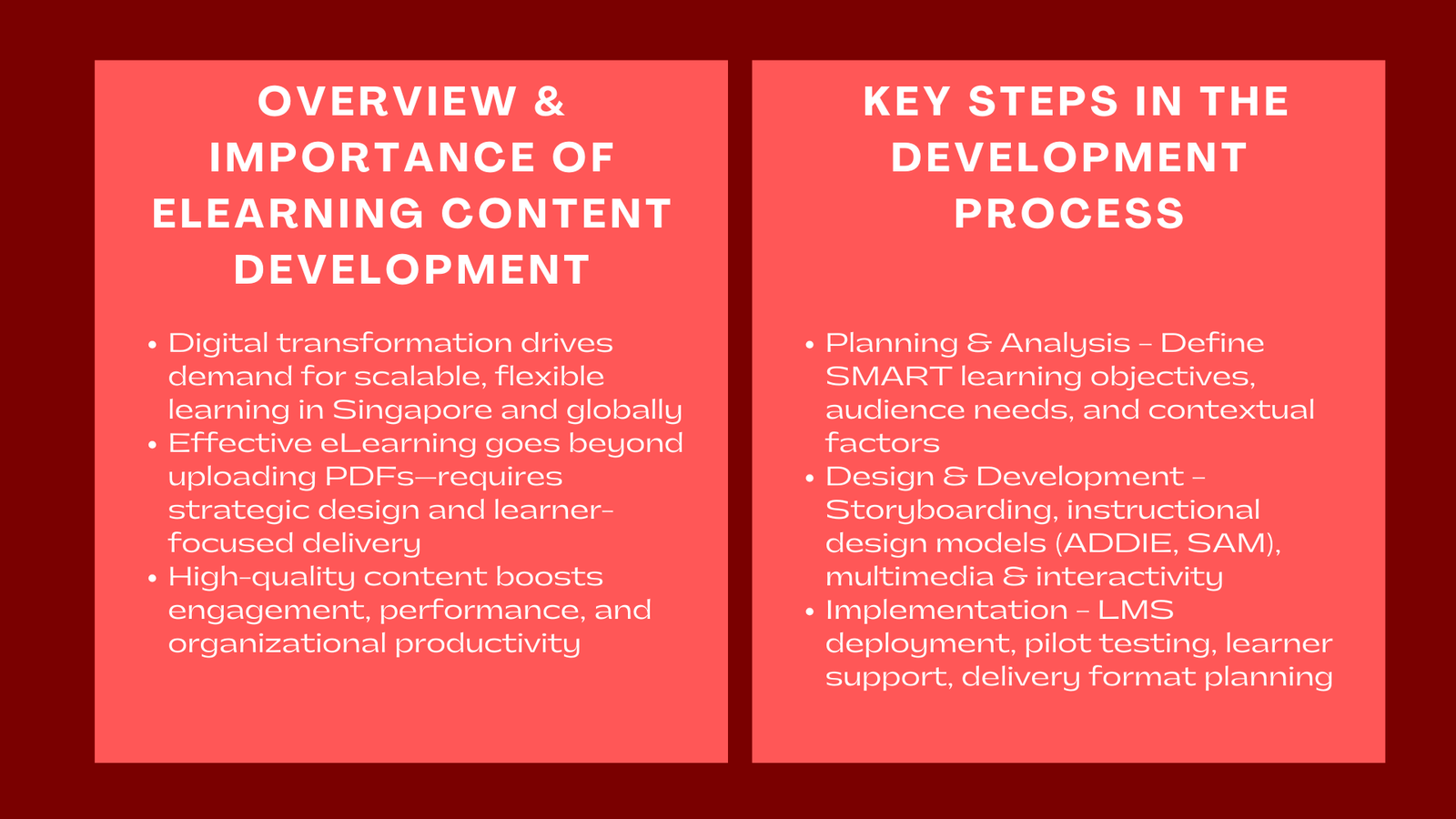
The digital transformation has been remaking learning environments both in Singapore and other parts of the world. Eduardo et al. (2015) argue that businesses, schools, and government departments are progressively turning to eLearning to train their workers, educate learners, and transfer knowledge to them in the most effective way. The conventional classroom-based training systems are no longer adequate to accommodate the ever-increasing flexibility, access and real time learning requirements. This is because organizations have now realized that a properly designed digital learning program can be a valuable means of not only increasing the level of knowledge but also the engagement, performance, and the overall organizational productivity of the employees.
Nevertheless, the effectiveness of the eLearning programs is closely dependent on the quality of the content. There is more to eLearning contents than just uploading of presentations or PDFs to a learning management system. It entails a designed and strategic plan, to be applied in integrating specific learning goals, audience perception, instructional design practices, interactivity, multimedia, tests, and continuous enhancement. The best programs are also based on the learner engagement, inclusion, access and relation to the general organization as well.
eLearning content development would also demand special skills and hence this factor has seen most organizations in Singapore collaborate with professional eLearning content development services. On these services, there is knowledge transfer on adult learning concepts, multimedia production, assessment development, and technical integration that guarantee interaction in the learning process is not only interesting, but also efficient. This article is a detailed step-by-step eLearning content development process Singapore procedure in the generation of high-quality eLearning content, which allows maximising the learning process and ensures impactful business changes that can be measured.
Planning and Analysis
Define Clear Learning Objectives
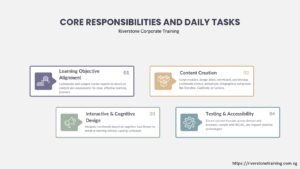
An effective eLearning course is based on the learning objectives. Clear objectives also offer the instructional designers a sense of direction, content development and clear expectations by the learners. The SMART criteria which consist of specific, measurable, achievable, relevant and time bound are an effective model of setting goals. These goals also enable the organizations to quantitatively assess the effectiveness of training, especially in the development of e-learning content in Singapore, where measurable outcomes are essential for workforce upskilling and compliance.
As an example, an objective within a corporate compliance module would be: by the end of this module, the employees should be in a position to name five important compliance regulatory steps and use them properly in their daily reporting activities. This is the kind of accuracy that will assist the designer in deciding on the course content and use the right multimedia contents and aim to come up with insightful assessments that demonstrate desirable learning outcomes. Effective learning objectives also allow managers to determine performance of employees after training so that the program helps to achieve more business objectives.
Audience and Needs Analysis
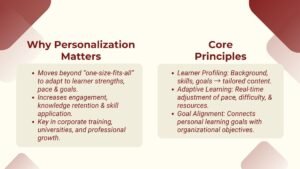
It is also important to know the characteristics of the learners and this is critical to the success of any eLearning program. The audiences possess different degrees of previous knowledge, abilities as well as learning preferences. An example of that is with the adults who usually like the scenario based learning, independent modules, and material that specifically relates to their work in relation to job responsibilities. Gamified experience, interactive simulation, and the visually active material may be more effective with younger learners.
In many cases, professional eLearning content development services for organizations Singapore are performed through elaborate audience analysis based on surveys, interviews, and focus groups to receive visibility on the level of technical skills, familiarity with content, learning styles, and motivation factors of learners. This statistical methodology makes the content interesting and involved so as to reduce the disengagement and dropouts. Moreover, knowing the needs of the audience will enable developers to foresee the possible issues and create some conducive solutions, including adding more exercises to difficult topics.
Contextual Considerations
Design and Development
The organizational setting, workflow, available apparatus, and the technical infrastructures have a major influence on the formulation of eLearning content. An example is that the field-based employees might need the modules that are accessible via mobile devices and that the employees in offices might use desktop-based education. Time is another important element that should be taken into account in order to make the contents short and easy to digest and work effectively in the timetable of learners.
The other factors are the network bandwidth, compatibility of the device and the availability of the software. Knowing these contextual aspects at the initial stage of the planning process, the instructional designers will develop the continuous flow of learning that will reduce the number of technical obstacles and increase the chances of access to all learners.
Storyboarding and Instructional Design
A storyboard is a necessary part of the development of eLearning. It enables the designer to have a visual representation of the course flow, which comprises screen layout, placement of text, integration of multimedia, interactive features and the evaluation points. An elaborated storyboard can allow the stakeholders to get the feedback prior to the starting of the development which in turn has lower revision, avoids misalignment with the aim and will ensure that the cost of development is controlled.
Instruction design is used to organize the content in a logical way, make the use of effective teaching strategies and keep to the learning objectives. In models of instructional design, including ADDIE (Analysis, Design, Development, Implementation, Evaluation) and SAM (Successive Approximation Model), procedures are given that allow the creation of content in a systematic and continuous way. It is through these models that the developers are able to design learning experiences that are coherent, sound in pedagogy, and audience-centered.
Multimedia Integration and Interactivity
The integration of multimedia helps in learning because it addresses different ways of learning. The videos, animated content, infographics, and audio narration can help to simplify the too complicated concepts, show how the concepts can be applied in the real world, and keep the learners engaged. Interactive features like quizzes, drag and drop activities, and simulations involving scenarios allow the learners to use the knowledge they learn and not to consume passively.
An example is a software-training module which can be used to simulate user interfaces to enable learners to practice actions in a secure setting without the potential of communicating some actions to a live system that could lead to mistakes. These kinds of immersions not only enhance the processing of knowledge but also make the learners more satisfied and willing to use what he or she learns on the job. Professional eLearning content development services are exceptional in creating such dynamic interactive experiences in that the content is engaging, relevant and one that meets learning goals.
Accessibility and Inclusivity
Eugenic and friendly design of eLearning gives the poor a chance to be fully engaged in the eLearning. English provisions Accessibility elements are video captions, readable text using screen readers, high-contrast visual objects, and alternative navigation. Also, inclusive design takes into account other diverse cultures, languages, and learning styles, to provide a fair chance to participate.
With the focus on inclusivity and accessibility, the organizations not just do not break the regulations but also create the atmosphere in which every employee has chances of emerging. The strategy will improve interaction with learners, promote good corporate culture, and portray dedication to diversity and equity in learning in the workplace.
Implementation and Delivery
Learning Management Systems (LMS)
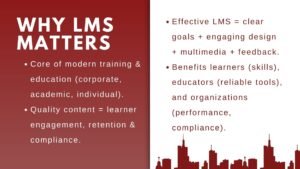
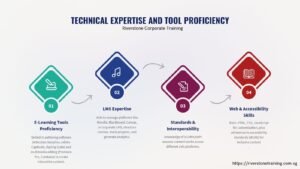
The Learning Management System (LMS) is required with a strong power to provide, monitor and regulate eLearning programs. Through an LMS, learners are able to view material, track their course and take tests and be awarded certifications. The recent LMSs facilitate mobile learning, gamification, social learning and analytics which creates actionable insights to the learning managers.
The correct choice of LMS will guarantee the presence of scalability, the ability to integrate with the organizational systems, and the successful deployment. Such capabilities as automated reporting, customizable dashboards and learner analytics will help managers assess the effectiveness of the course, pinpoint knowledge gaps, and conduct focused interventions with a considerable level of efficiency.
Pilot Testing and Feedback
Pilot testing plays a very important role during implementation. Testing a module on a small scale with a group of learners would enable the instructional designers to determine usability problems, content voids, and technical difficulties. The responses of this pilot lead to some refinements, to make the process of rolling out the module within the organization a success.
Constant feedback loops and repetitive testing are important in ensuring that eLearning content is of high quality. With such an action, the developers can cover the areas of concern, enhance the course, and make the course relevant, efficient, and pleasant in the long-term.
Content Deployment Strategies
Success of eLearning programs depends on good implementation plans. There are some options like self-paced modules, hybrid models that involve online and instructor-based sessions or the all-online model that uses instructor-based sessions. Implementation can be planned with a performance cycle, compliance deadline or skill development initiative to ensure optimization in terms of impact. Considerate scheduling and planning help in implementing training in the day to day activities of learners in a manner that does not affect their lives but increases the level of engagement and final completion.
Evaluation and Continuous Improvement
Measuring Learning Outcomes
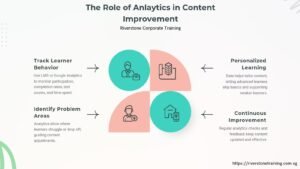
Knowledge acquisition, the practice of skills, and the engagement of learners were some criteria used to measure learning outcomes. Tests, exams, simulation games, and real-life assignments give objective results of learning. The completion rate, interaction with content, and post-training performance can be observed and allow assessing the effectiveness of the programs provided by the organizations.
Learning analytics also allow situations where learners are weak to be pointed out, and strategic interventions, supportive arrangements, and compromise changes to content can be executed. Through outcomes being measured thoroughly, an organization could make sure that eLearning programs produce significant value and facilitate organizational results.
Iterative Updates and Relevance
Constant changes in the content are necessary to ensure relevance and effectiveness of courses. The policies, procedures, and technologies also transform and the eLearning material should be refreshed to be precise and useful. The reviews will make sure that the learners get up-to-date information, boosting their compliance, productivity, and confidence.
The services related to the development of professional eLearning content are usually continuous support, revision, updating, and improvement of the courses as the needs of the organization develop. Such a dynamic process is critical to eLearning since the process will be a living one and not a dead one and therefore maximizes its income over time.
Best Practices for Successful eLearning
The best practices allow eLearning to reach high quality. The presence of modular design units content into units that are easy to digest, enhancing the retention and comprehension of the content. The context of storytelling puts ideas into real-life situations whereby learning would be more relatable and memorable. It is recommended to use gamification as an instrument to maintain motivation through the use of points, badges, and challenges, whereas the learning based on scenarios mimics real-life conditions to practice the learned skills. Microlearning provides brief, focused teachings that save important pieces of knowledge and facilitate the just-in-time learning requirements.
When these practices are considered carefully, then, the learners will be more involved, inspired and can apply the knowledge that they acquire successfully into their practice thereby having tangible business results.
Conclusion
The process of developing effective eLearning content entails proper planning, designing, interaction, and multimedia approaches as well as delivery strategies. Companies with a holistic strategy in inducting new hires can develop a training process that is both participatory and knowledgeable and lead to direct business outcomes. The development of professional eLearning content services would offer expertise, technology, and the constant assistance to make courses relevant and engaging, as well as to make success a priority.
By investing in the high quality of eLearning, the Singaporean organizations will be able to empower its workers, create the spirit of constant learning and remain competitive in the modern world of the rapidly developing world of business. The structured, interactive, and data-driven content kind of learning will guarantee that it is not just consumed but applied so that employee skills can be developed, their performance can be enhanced, and they can become useful in terms of their contribution to organizational goals.