Video-Based eLearning: Engaging Learners with Visual Content
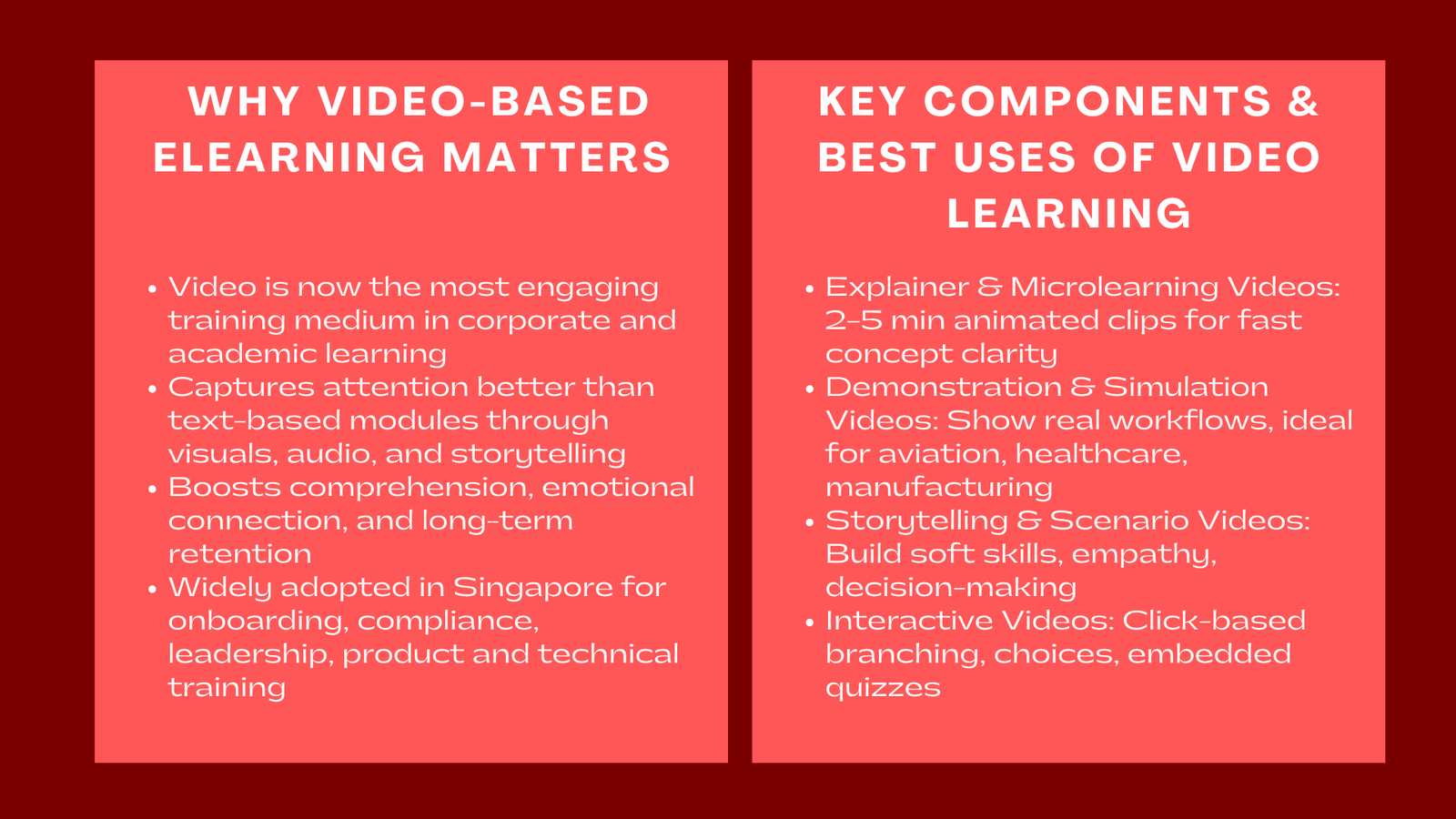
In today’s digital-first corporate and academic environment, video-based eLearning has emerged as one of the most effective and engaging mediums for delivering training at scale. Visual content naturally captures human attention far better than text-heavy or static presentations, leveraging the brain’s innate preference for visual processing. By combining audio, visuals, and narrative, video-based learning promotes comprehension, emotional engagement, and knowledge retention far beyond what traditional eLearning modules can achieve.
Organizations across Singapore—from multinational corporations to higher learning institutions—are increasingly embracing video-based learning not only for its accessibility and efficiency but also for its ability to humanize digital education. Videos provide a narrative, tone, and authenticity that written or static modules cannot replicate. They have become essential for a wide range of applications, including onboarding new employees, compliance training, leadership development, product demonstrations, and technical upskilling, often complemented by interactive eLearning content Singapore to further enhance engagement and learner participation.
The widespread adoption of affordable production tools, integrated Learning Management Systems (LMS), and high-quality streaming technologies has democratized video creation. Modern learners now expect to access content anytime, anywhere, often preferring on-demand video modules over traditional instructor-led sessions. Video-based eLearning is reshaping how knowledge is shared, experienced, and applied, creating more immersive and learner-centric training ecosystems.
The Relevance of Video-Based Learning
Meeting Modern Learner Expectations
Modern learners, particularly digital-native professionals, increasingly expect dynamic, visually engaging content. Their habits are shaped by popular media platforms such as YouTube, Netflix, and TikTok, where short, concise, and visually compelling content dominates attention. Video-based learning mirrors these consumption patterns, offering concise, interactive, and easily digestible content that aligns with how learners process information in today’s digital landscape.
According to the LinkedIn Workplace Learning Report, 73% of employees prefer watching short videos over reading documents or attending live sessions. This shift in learner behavior necessitates that training programs evolve to maintain engagement while providing content that is both relevant and actionable. For Singapore organizations competing in highly regulated and knowledge-intensive industries, meeting these learner expectations ensures that employees acquire skills effectively and efficiently.
Enhancing Retention and Comprehension
Video-based eLearning aligns with the cognitive theory of multimedia learning, which posits that humans learn more effectively when verbal and visual information is processed simultaneously. The combination of text, images, motion, and audio stimulates multiple sensory pathways, resulting in stronger memory formation and better knowledge retrieval.
For example, concepts demonstrated through animations, storytelling, or real-life examples have been shown to stick longer than those presented in static text. A study by the National Institute of Education (Singapore) indicated that students exposed to video-based instruction performed 22% better in comprehension assessments compared to peers using text-only materials. This demonstrates that integrating visuals with audio not only aids understanding but also accelerates skill acquisition and reduces the cognitive load on learners.
Core Components of Video-Based eLearning
Explainer and Microlearning Videos
Explainer videos break down complex concepts into short, engaging narratives that combine animation, motion graphics, and voiceovers. When designed as microlearning videos of 2–5 minutes, they allow learners to focus on one topic at a time, which enhances comprehension and retention while reducing cognitive fatigue.
Example:
A fintech firm in Singapore developed three-minute animated explainers to simplify blockchain technology and data privacy principles for new hires. Post-training surveys revealed a 40% improvement in conceptual understanding.
Explainer videos are particularly effective for onboarding, compliance training, and refresher modules. Their concise format allows learners to revisit content on demand, enabling continuous reinforcement without interrupting daily workflows.
Demonstration and Simulation Videos
Demonstration videos illustrate real-life processes, software workflows, or product operations, making them highly effective for procedural training and operational accuracy. Simulation videos further enhance interactivity by allowing learners to visualize outcomes of decisions in a risk-free virtual environment. Industries such as aviation, healthcare, and manufacturing benefit significantly from this method.
Case Study:
Singapore Airlines employed simulation-based safety training videos for flight crew members, resulting in a 30% improvement in procedural compliance scores. These videos allowed crew members to rehearse emergency procedures repeatedly without physical risk, enhancing both confidence and performance under pressure.
Demonstration and simulation videos bridge the gap between theoretical knowledge and practical application, enabling learners to transfer skills directly to the workplace.
Storytelling and Scenario-Based Videos
Narrative-driven videos leverage storytelling, case studies, or dramatized scenarios to convey behavioral and leadership lessons. This approach strengthens emotional connection and helps learners internalize values, ethical principles, and soft skills that are difficult to teach through traditional methods.
Example:
A retail brand in Singapore developed scenario-based videos depicting real customer service challenges. Staff engagement increased threefold, and complaint resolution times decreased by 25%. By presenting learners with relatable dilemmas, storytelling videos cultivate empathy, critical thinking, and decision-making skills.
Interactive Videos
interactive and scenario-based video learning Singapore allows learners to make choices, click on embedded elements, or explore branching pathways. For instance, a compliance training video may pause at a decision point, prompting learners to select the correct action before continuing.
Active participation in these videos improves focus, reinforces learning objectives, and enables personalized pathways based on individual decisions. Popular tools for creating interactive experiences include H5P, Articulate Storyline, and Kaltura.
Live and Recorded Webinars
video-based eLearning solutions for corporate training Singapore extends beyond pre-recorded modules. Live sessions conducted via Zoom, Microsoft Teams, or Webex facilitate real-time engagement with instructors, while recordings can be archived for on-demand learning.
Best Practice:
Singapore-based corporations often host monthly leadership webinars. These sessions are recorded, edited, and tagged for easy search in their LMS, creating a long-term corporate knowledge repository accessible across departments.
Implementation Strategies for Video-Based eLearning
Align with Learning Objectives
Each video must have a clear purpose—explaining a process, demonstrating a skill, or shaping behavior. Training teams should link videos to specific competencies, compliance standards, or leadership development goals.
Tip:
Map each video to Bloom’s Taxonomy levels to ensure a balanced learning design, from remembering and understanding to applying, analyzing, and creating knowledge.
Maintain High Production and Audio Quality
While cinematic production is unnecessary, quality impacts credibility and engagement. Poor audio, inconsistent lighting, or distracting visuals can reduce learner attention. Subtitles, clear narration, and consistent branding enhance professionalism and inclusivity.
Example:
A Singapore government agency implemented standardized production templates and voiceover guidelines across all eLearning videos, building learner trust and recognition across departments.
Optimize for Mobile and Multiplatform Delivery
Modern learners consume content across multiple devices, including smartphones, tablets, and laptops. Videos must be compressed for smooth streaming without sacrificing quality. Additional features like chapter markers, playback speed options, and transcripts further improve user experience and accessibility.
Integrate Assessments and Feedback
Embedding quizzes, polls, or reflection prompts within or after videos promotes active learning and helps track comprehension. LMS integration enables measurement of completion rates, view duration, interaction clicks, and quiz performance, providing actionable insights for improving course design and personalization.
Localization and Cultural Relevance
For multinational organizations, adapting visuals, language, and examples to local work culture increases relatability. Singapore-based organizations often localize global content to reflect Asian workplace norms, enhancing engagement and learner satisfaction.
Enhancing Strategic and Analytical Thinking through Video Learning
Scenario-Based Decision Training
Video learning can simulate complex business scenarios, teaching strategic thinking and analytical skills. Employees can observe how leaders make trade-offs, analyze potential outcomes, and debate decisions in workshops.
Example:
A Singapore investment firm produced video-based strategy cases where managers discussed real portfolio decisions. Employees subsequently debated these cases, enhancing cross-functional insight and critical thinking.
Reflective Practice through Playback
Videos that record learner performance—such as client roleplays, presentations, or simulations—enable self-review and reflection. AI-driven feedback can identify strengths and areas for improvement.
Case Study:
A leadership program incorporated recorded presentation reviews with AI feedback. Participants improved clarity, persuasion, and confidence within six weeks.
Peer Learning through Discussion Videos
Incorporating discussion prompts at the end of videos encourages learners to share interpretations, insights, and applications. This transforms individual learning into collaborative knowledge exchange, building a community of practice.
Technology Integration and Automation
AI-Powered Analytics
Artificial Intelligence analyzes engagement patterns, identifies drop-off points, and recommends personalized learning pathways. AI-driven transcription and translation further enhance accessibility for diverse learners.
Example:
A Singapore tech firm found that videos under six minutes had 50% higher completion rates, leading to a redesign of their training library based on AI insights.
Cloud-Based Video Hosting
Cloud platforms like AWS Media Services and Vimeo Enterprise provide scalable, secure hosting with real-time tracking. Singapore firms ensure PDPA compliance by hosting data locally or in aligned regions, preserving data sovereignty.
LMS Integration
Embedding videos within LMS platforms such as Moodle, Docebo, or Cornerstone enables seamless tracking, certification, discussion boards, and adaptive learning paths, creating a fully integrated learning ecosystem.
Video Creation Tools and Accessibility Enhancements
Tools like Camtasia, Powtoon, and Adobe Premiere Rush empower internal teams to produce professional-quality videos efficiently. Subtitles, high-contrast visuals, and sign language inserts enhance inclusivity, ensuring accessibility for all learners.
Advantages of Video-Based eLearning
Video-based eLearning delivers high engagement by combining audio, visual, and narrative elements. It offers flexibility with 24/7 access, scalability for global workforces, and consistent delivery of corporate policies or technical knowledge. Video learning supports retention and recall through visual reinforcement, enables measurable analytics, and fosters emotional connection through storytelling. Additionally, it reduces costs associated with repeated live sessions and physical training materials.
Conclusion to Video-Based eLearning Engaging Learners with Visual Content
Video-based eLearning is far more than a digital trend—it is the cornerstone of modern learning strategies. By blending narrative, visual storytelling, and data analytics, it transforms passive learners into active participants. Singapore organizations that adopt video strategically benefit from higher engagement, improved compliance, and faster skill development. Well-designed video content not only educates but also inspires, ensuring that learners internalize knowledge and apply it effectively. Through structured, accessible, and interactive video modules, organizations can create enduring learning ecosystems that empower employees and strengthen corporate performance.