Creating Learner-Centric eLearning Content for Maximum Engagement

Creating Learner-Centric eLearning Content for Maximum Engagement

In today’s world of speedy processes and digital engagement, the effectiveness of corporate training relies on one important aspect of it all; engagement. Without it, even the best-designed courses, or most advanced learning technologies, will never meet their potential. The way around this is by creating learner-centric eLearning content, where the focus is less on what an organization wants to teach and more what the learner actually absorbs, processes and applies information.

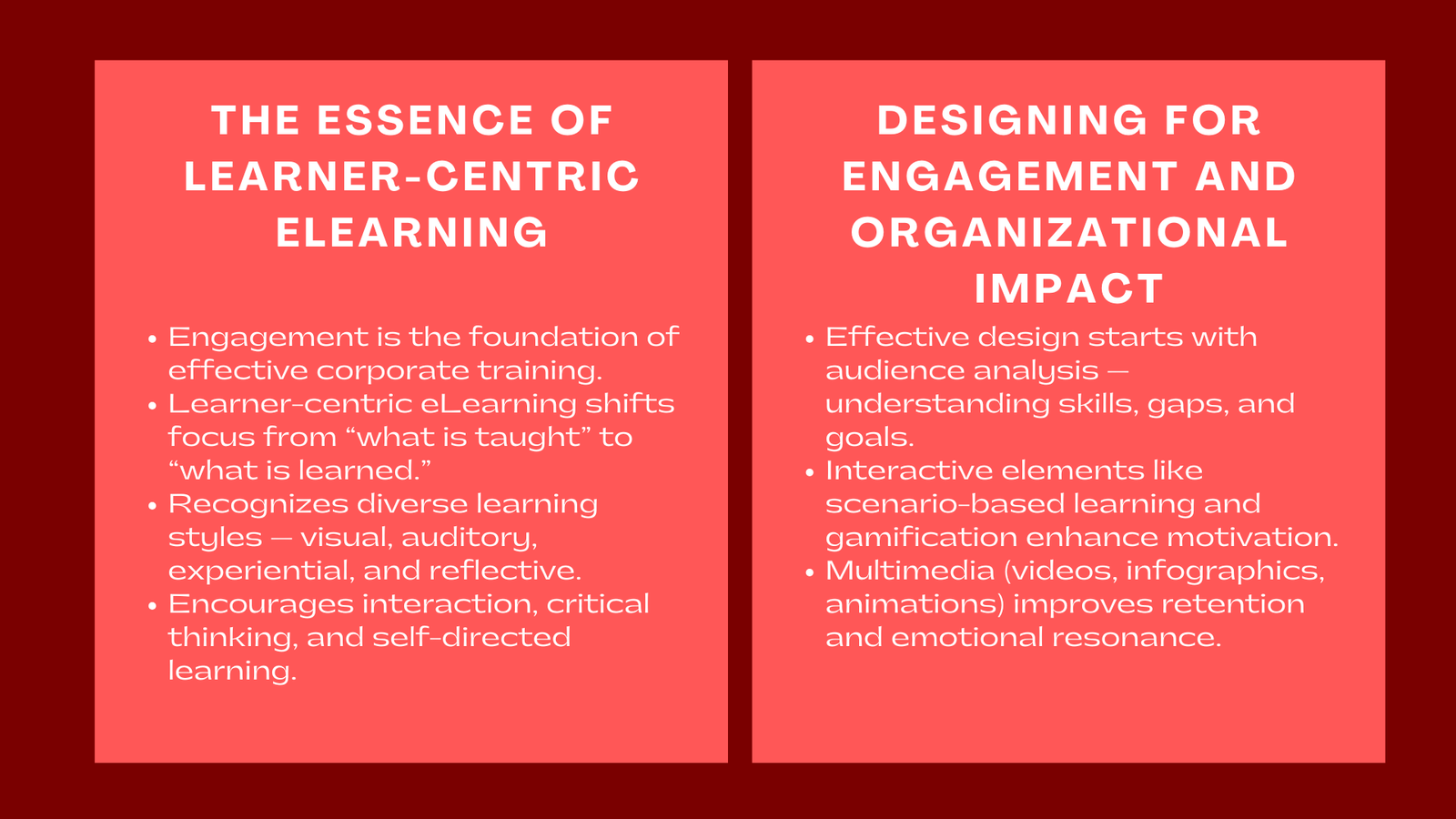
Learner-centric eLearning is much more a discipline of thought than a strategy. It acknowledges that all employees are in some way not all auditory as they learn: via visual, practical, storytelling or reflection but that the learning key to maximum engagement is personal relevance. Instead of teaching content in a lecturing mode, learner centered design calls for interaction, critical thinking, and self-directedness. The result is a more immersive learning experience that not only helps to better retain knowledge, it helps to improve performance and motivation, especially in today’s diverse workforce where global eLearning content in Singapore supports inclusive, culturally adaptive, and engaging learning environments.

As organizations invest more in eLearning platforms, distinguishing between the high and not-so-high-impact courses can be reduced down to the quality of design. Content that strikes parents in an emotional and intellectual way has the ability to take training from a compliance exercise to a growth-inducing experience. This article delves into how to engineer an eLearning content that is genuinely learner centric and what are the strategies that improve engagement and why it results in a more sustainable learning outcome.
Creating Learner-Centric eLearning Content for Maximum Engagement

Understanding the Learner-Centric Approach in eLearning

The term “learner-centric” goes beyond customization – it embodies a holistic way of thinking that puts its learner at the core of his or her education. Traditional training models are traditionally instructor-led and one-directional, i.e., focused on information rather than comprehension. In any event, the learner-centric eLearning content strategy recognizes people don’t learn best when they are passive participants in the learning process.

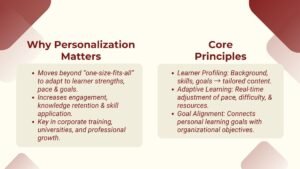
In this model, learners are responsible for their progress and instructional designers play the role of a facilitator, not a lecturer. The content adjusts to the individual skill level, preferences, and learning goals of each person so as to make sure that each participant is both challenged and supported. This way, relevance is also emphasized – linking to real life situations and job tasks for each learning module. When employees are able to see the immediate applicability of what they are learning, the engagement goes hand in hand.

A very important role in making this personalization possible is technology. Learning Management Systems (LMS) and Learning Experience Platforms (LXP) presently gather and comprehend the information of the user to customize them dynamically. For instance, if a learner finds it difficult to grasp a particular topic, the system may automatically suggest further tutorials, whereas learners who are faster thinkers can move forward the lessons to advanced modules. This is a form of adaptive capability which turns eLearning into a responsive ecosystem which reflects the pace and need of the learner.

Another key element to a learner-centric eLearning is emotional connection. Neuroscience has demonstrated that emotion and cognition are tightly interrelated – people will recall information more when they are experiencing emotion while learning the information. By combining the elements of storytelling, scenarios that can be relatable and easy-to-digest, and visual design that sparks curiosity, content developers can turn stale information and information into memorable experiences. As stories in video form, or gamified simulations, or interactive case studies, the learner-centric approach takes learning from being a task to being a journey.

Ultimately, absorbing the diversity of the learner implies embracing diversity of learning preferences. Some employees learn visually through graphics or a video, some like reading and reflection while many learn more effectively from social learning – discussion, collaboration, and feedback. By creating eLearning content that caters for those learning styles, organizations can create an inclusive environment where maximum participation and retention can be achieved.

Designing eLearning Content That Drives Engagement

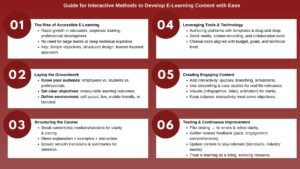
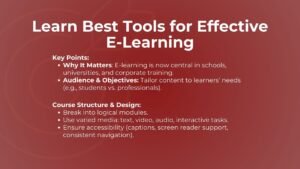
Making learner-centric eLearning content begins with having knowledge of the psychological function of motivation. Based on this insight, learners are most engaged when they say that a training is valuable, relevant and rewarding. This means that eLearning content needs to be broken into well-defined objectives, stories that people can completely relate to, and engagement activities.

Good design begins with analysis of the audience. In order to design any materials, instructional designers must know the learner and his current abilities and problems faced in their works. This means that all modules focus on real life needs instead of generic learning material. Armed with these insights, learning development teams can create learning paths that speak directly to those needs: filling the information gaps that exist and improving job performance.

While interaction is at the center of engagement. By design, when they click and drag, decide and answer skill level questions, they are no longer inactive recipients, but active participants. Scenario-based learning and gamification are two proven methods that are used to achieve this engagement. In scenario-based learning, the learners are placed in life-like simulations where they take decisions and experience repercussions in a framework. This way, not only is retention increased, but confidence in putting skills into use at the workplace is also increased.

On the other side, used is gamification, which appeals to the human aspect of achievement and rivalry. Through points, badges, challenges and rewards it makes learning fun. However, gamification in eLearning is not just for surface entertainment but helps drive learner-centric eLearning content development services for corporate training purposes by making meaningful use of feedback and progression features. As well as being fun, when used properly, it does cause learners to get motivated and come back for more.

Dramatic and audio-visual components are also bound to spark interest. Videos, infographics, animations, and narrations that simplify the information into concepts that can be better remembered and understood. The strategy is to treat graphical imagery as a tool – to make information visual, direct viewers’ attention to it and keep them there. Even more importantly , speculative content can become relatable and generally usable provided with serious linguistic messaging as well as attractive images.

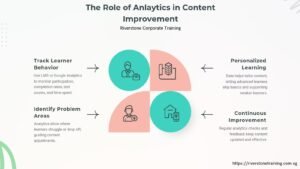
And finally, engagement relies upon feedback and reflection. Post-modular activities – adding brief quizzes, polls or reflection statements after a module will encourage learners to evaluate their existing knowledge and act upon what they’ve learnt. This feedback loop makes one feel good as well as helping to briefly cement knowledge. By combining analytics capabilities, the organizations can map the performance data to locate those areas where learners face issues and carry out an ongoing improvement in content design and delivery.

The Organizational Benefits of Learner-Centric eLearning

Beyond creating more engagement for individual learners, learner-centric content for eLearning generates a measurable organizational value. Companies with a priority on personalized and engaging learning experiences see boosts not only in training outcomes, but also on employee satisfaction, retention and productivity.

When learners are encouraged to be involved, they are able to retain information better and put it into practice in a more accurate manner in real-world scenarios. This minimizes knowledge gaps and decreasing errors which as a result gives a boost to the hastening time required to reach competence. Moreover, employees who believe that training is meaningful and relevant to their jobs stay with the organization more so. In this manner, learner smaller design is strong retention strategy as well as a development tool.

And, engaged learning facilitates innovation and collaboration. When employees experience learning through eLearning as a dynamic and interactive learning process, they will be more open to some experimentation, customized digital learning solutions for employee engagement and performance, peer learning, and continuous improvements. This culture of curiosity can impact the way that teams work together to solve problems and communicate. It transforms the nature of training from top down directional to shared experience of growth and discovery.

From a financial point of view, organizations are reaping the advantage of the scalability and efficiency of eLearning. Once they are designed, (poser) learner-centric modules can be deployed on global teams at minimal additional cost. Adaptive systems give the power to keep content relevant through updates and personalised recommendations that have been automated. The return on investment has increased over the years as the same eLearning infrastructure provides support to new skills, roles, and departments.

Most important though, learner-centric content helps drive more alignment between corporate objectives and employee performance. Each training module can be directly mapped against business outcome propositions – whether it’s improving sales performance, improving compliance or developing leadership. When learning strategies are data driven and employee focused, organizations are successful both in terms of education and operation.

Conclusion to Creating Learner-Centric eLearning Content for Maximum Engagement

In an information-overload and fast-changing age, engagement is the new yardstick by which training effectiveness is measured. The key to achieving this engagement is creating eLearning content that is learner-centric – that is, content that honors the way people learn as well as motivating them to participate and empowering them to apply this knowledge with confidence.

Organizations that take this approach are not just updating their training programs; they are changing their culture. By having learners at the center of the design process, companies signal that they value growth, curiosity and empowerment. In return, employees respond in terms of loyalty, enthusiasm, and higher performance.

The whole point of eLearning in the end is not to impart knowledge but to get actions. Learner-centric design attains this by linking content, purpose and personalization as well as passion. As technology continues to advance, it’s going to be the organizations that are able to harness the power of learner centered eLearning to build agile, engaged and future-ready workforces, where learning isn’t an event and more an on-going experience of growth and engagement.

Related Posts

Everything You Need to Know About E-Learning Courses

Gain flexibility and expertise with online finance training. Contact Riverstone Training today to explore our e-learning finance programs.